Thirty years ago today, R.E.M. released New Adventures in Hi-Fi.
I’ve listened to it twice today. I love this album so much. The songs are great, and I loved many of them at the time. I’ll vouch for Bittersweet Me any day of the week and twice on Sunday. One of many songs where Mike Mills conveys so much in a background vocal without saying a word.
But at this point in my life the album is a time machine, and its power comes in part from its ability to connect me to my 21-year-old self, to close my eyes and be back in my dorm room.
I can feel that terrifying and exhilarating combination of knowing my place in the world, and knowing that it would all go away in a couple of months. That the future was wide open, but I didn’t have the faintest clue what to do with it. (The number of career possibilities I cycled through that year must have exhausted everyone around me.)
No wonder I listened to Leave so many times.
1996 was the year Pattie and I got together. Our first official date as a couple was to go out for dinner, 30 years ago tonight, and stop by a record store to pick up New Adventures before returning to campus. I’ve told that story before, but heck, even that post was 15 years ago.
God, the band retired 15 years ago this month. So much time. So many memories. Isn’t amazing how music keeps the memories alive, and allows time to give them even more depth and meaning and perspective?
1996 isn’t in the running for the best year of my life. But it’s probably the winner in the “Years Before I Became a Dad” category. And when I mind-meld with that college senior sitting in the Bronx, I cry and I laugh because he has no idea – he’s barely brave enough to hope – that thirty years down the line, he’s going to have a daughter who trades R.E.M. references with him.
Such a long road since 1996. So many bumps and twists and turns and disappointments and triumphs. I doubt R.E.M. had any idea what was ahead of them. I know I didn’t know what was ahead of me.
But I’m so glad I’ve had this album along for the ride.
I was worried I didn’t have much new to say about DC’s comics from March 1984, but then I got going, and yeah, I had some thoughts. (Check out the Intro to this series if you want to know why I’m doing this or to check out the other posts.)
PLOT PERILS: I haven’t done an official count, but if you asked me who has written the largest number of my favorite comics, Mark Waid is at minimum a strong contender for the number one slot. In a recent episode of the Off Panel podcast hosted by David Harper, Waid said that he had to unlearn lessons he had learned while working for longtime DC editor Julius Schwarz, who prioritized a story’s plot to the point where “you could swap the balloon tails with any two characters and it wouldn’t matter.”
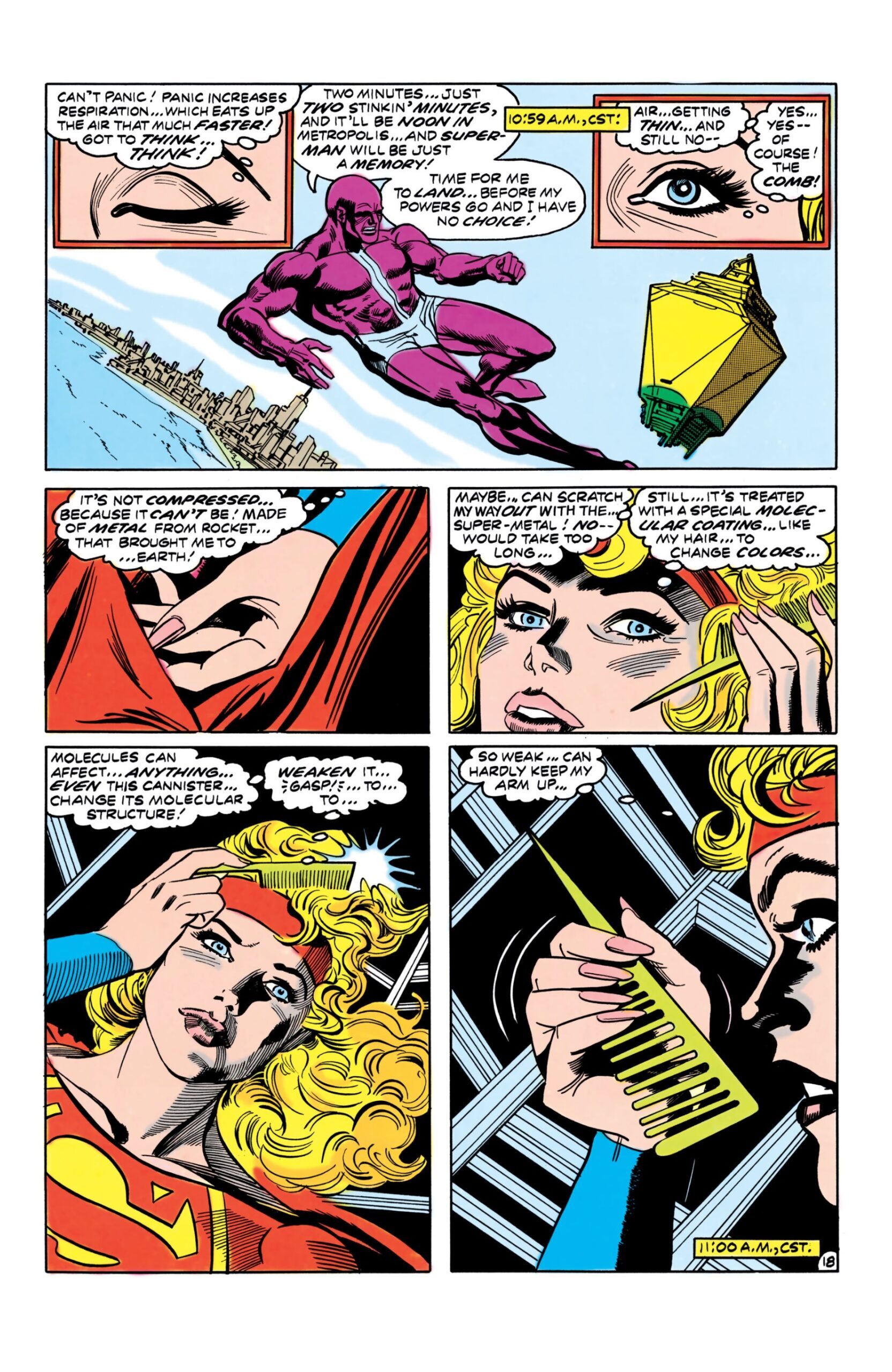
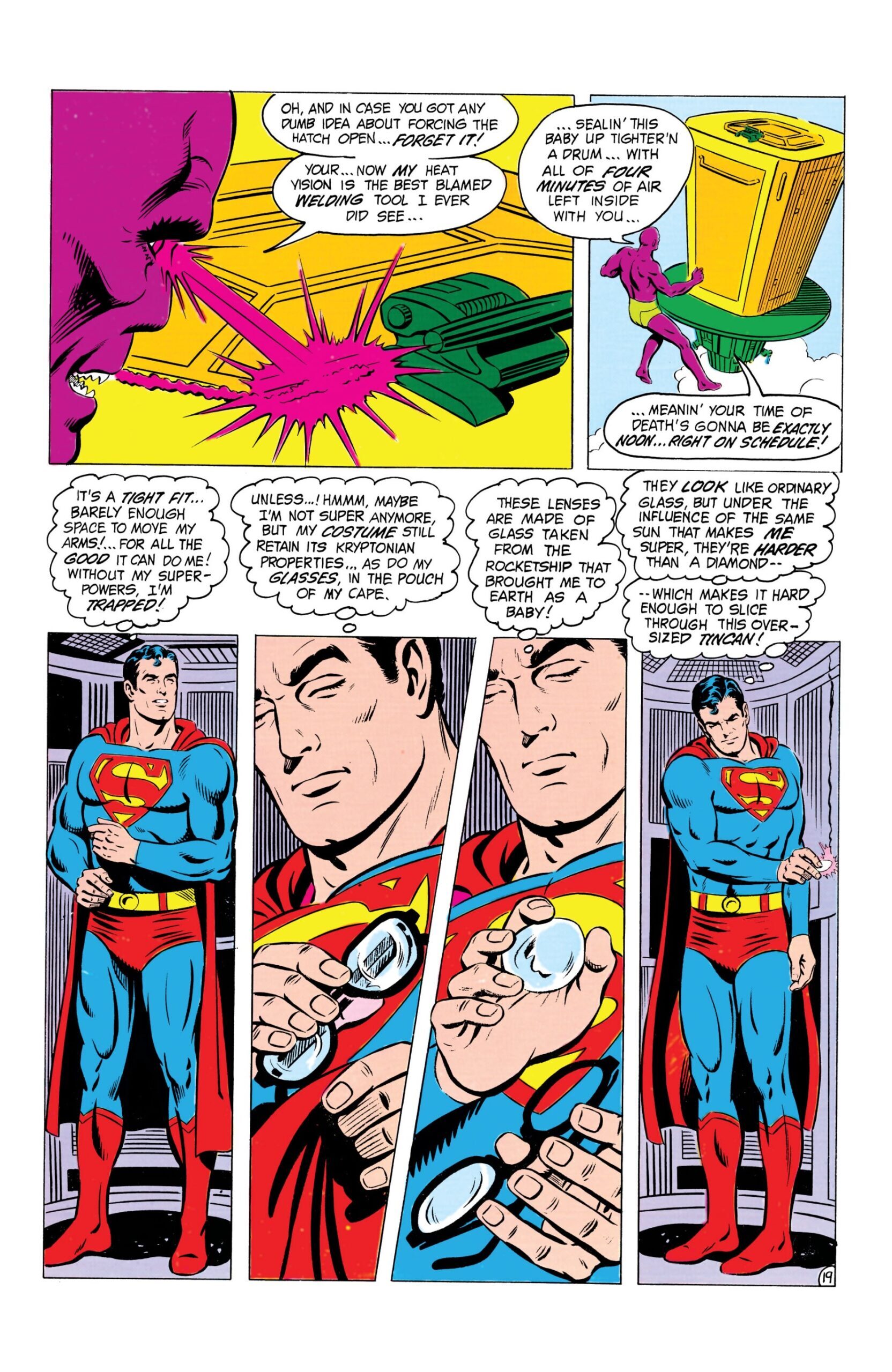
Schwarz was still editing the Superman titles in 1984, and boy, do I understand what Waid was talking about now, and I’m glad Waid made that switch. February’s issue of ACTION and March’s issue of SUPERGIRL are a two-part celebration of the anniversary of Supergirl’s first appearance. The entire story rests on a parallel structure in which Superman and Supergirl each face off against a foe in their respective cities, and each gets trapped in an allegedly-inescapable container. They each use a Kryptonian item that helps them maintain their secret identities as a way of getting out of the chamber and thwarting the super villain. The story exists to get the hero into a predicament and then, at the end, the hero uses a clever trick to escape the predicament. It lacks drama, it lacks stakes for the characters, it lacks personality.
Supergirl 20 Page 18 – Writer: Paul Kupperberg – Pencils: Carmine Infantino – Inks: Bob Oksner – Colors: Gene D’Angelo – Letters: Rod OllerenshawAction Comics 555 Page 19 – Writer: Paul Kupperberg – Pencils: Curt Swan – Inks: Dave Hunt – Colors: Gene D’Angelo – Letters: Ben Oda
And there is no way I am going to lay this at the feet of the writers. Paul Kupperberg was writing very different stories over on ARION, LORD OF ATLANTIS at exactly the same time. Marv Wolfman was writing his script for March’s issue of ACTION while he was writing The Judas Contract over on THE NEW TEEN TITANS. I have to conclude these Superman books are the way they are because that’s the kind of book Schwartz wanted. And that’s too bad. In 1984, I think Superman could have been a more interesting character with a different editor.
(Brief aside/disclaimer: In one sense it seems beside the point to talk about the work that Schwarz did, because based on what I think are credible reports that he was a sexual harasser, he shouldn’t have been doing it in the first place. But the work exists, and his influence is significant, so I will discuss the work. But even if these books were works of genius, that wouldn’t excuse the lack of respect Schwarz is said to have showed for artists and people.)
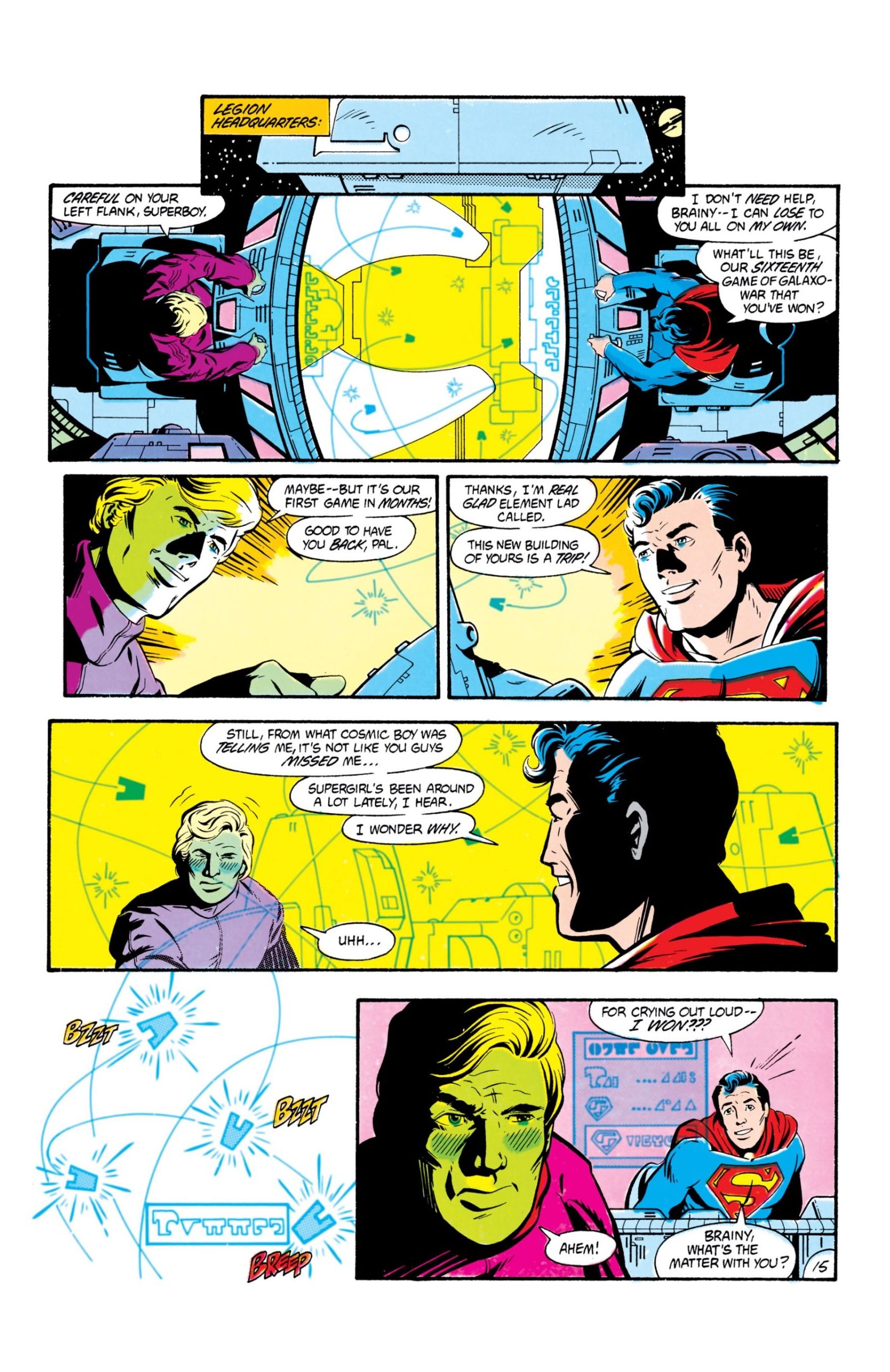
NOT QUITE SUPER IN LOVE: One type of character development that the Superman books did feature in 1984 was the romantic subplot. Kara in SUPERGIRL is having some issues with a musician she’s seeing, but at another point in her personal timeline, Superboy notices that she’s spending a lot of time in the 30th Century . . . which flusters Brainiac 5.
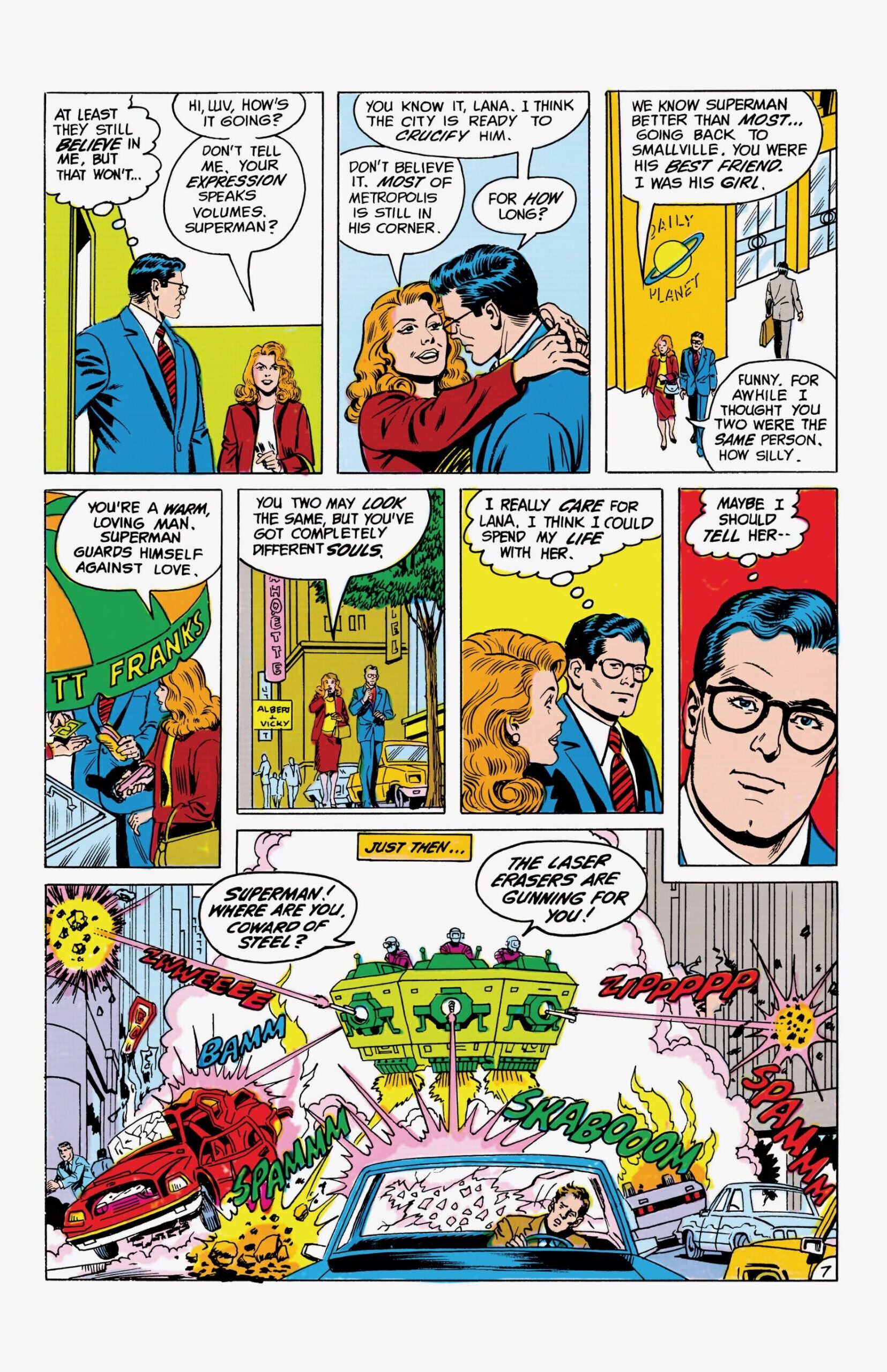
Meanwhile, over in ACTION COMICS 556, Lois Lane has taken herself out of the romantic picture and Clark Kent’s thoughts seem to be turning more to Lana Lang, who is also a reporter in Metropolis at this point. To me, this is an interesting path not taken. Most of the time I have seen Lana Lang interact with an adult Clark Kent, she’s representing the life and the world that he left behind in Smallville. To have her join Clark in Metropolis, and be someone who shared more of his life’s journey with him, is an interesting angle to their relationship, even if it risks making Lana too much like Lois Marv Wolfman implies that Lana isn’t the sort to jump off of tall things in order to get Superman’s attention – Clark thinks she’s more careful than Lois. This might be an attempt to avoid making the two characters redundant. I’m curious to see if the writers develop this angle over subsequent issues.
Legion of Super-Heroes 312 Page 15 – Writer: Paul Levitz – Pencils/Co-Plotter: Keith Giffen – Inks: Karl Kesel – Colors: Carl Gafford – Letters: John CostanzaAction Comics 556 Page 7 – Writer: Marv Wolfman – Pencils: Curt Swan – Inks: Kurt Schaffenberger – Colors: Gene D’Angelo – Letters: Ben Oda
As I thought more about these two scenes, it struck me that even though writers had spent the 1970s and 1980s aging the once-teenaged heroes of the Legion, Superboy was still the character traveling from the 20th Century to hang out with them, not Superman. I understand the Superman was often a member of the Justice League and teaming up with Batman in WORLD’S FINEST, so it may have been awkward to also have him team up with the Legion. (I know there are a handful of “Adult Legion” stories – I’m not counting those since they were not quite regular adventures of the team.) CRISIS ON INFINITE EARTHS and subsequent reboots wound up making this a moot point, but I wonder at what point it would be off-putting to have a teenage Superboy teaming with a bunch of adults, some of them with families of their own. Would it be a good idea to have Superman be an occasional member of the team, working with friends he grew up with on the super-hero side of his life along with the journalism side? I think so. On the other hand, I’m at an age where I reflect on growing older a lot more than the intended audience of these comics probably did!
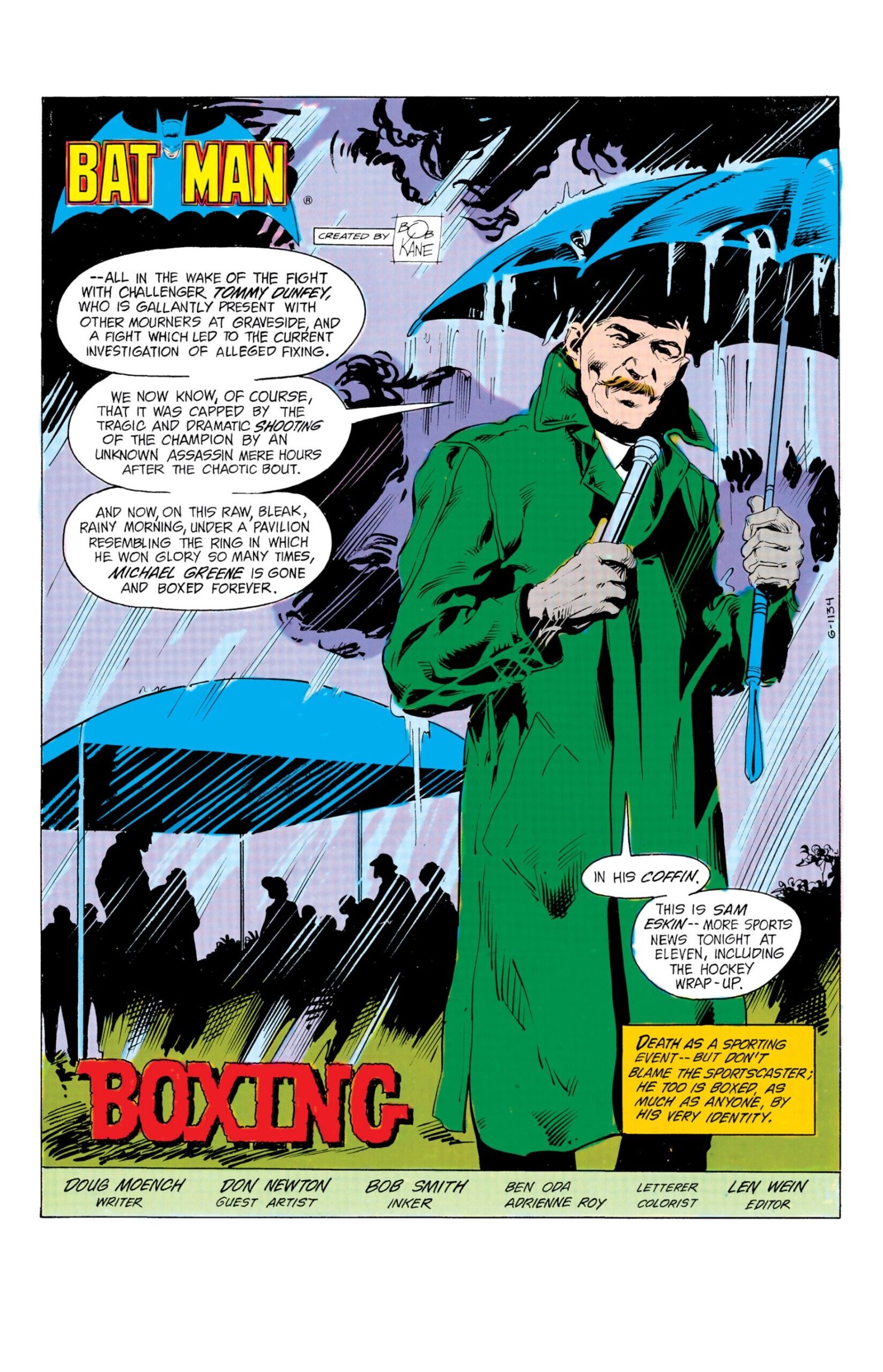
RACE AND THE RING: Doug Moench continues his monthly two-parters in BATMAN and DETECTIVE; this month, the crime lord Dr. Fang decides to manipulate the boxing world to schedule a fight that he will be able to manipulate for ill-gotten gambling gains. It was interesting to think about how in the early 1980s, boxing had a place in the public consciousness that made it a ripe metaphor for society’s racial conflict. Moench puts an underdog fighter being used as a pawn in Fang’s plan in the spotlight, and it’s an interesting character study.
I was frankly surprised to see how Moench doesn’t really hold anything back in this story – the racial tension is directly commented on, and Moench makes clear that the racists are terrible people. I was surprised to see a comic sold in 1984 use the N-word directly in the dialogue – even if the lowlife who uses it is immediately punched and deposited in a trash can. I asked about this on Bluesky and several people pointed out that it was not uncommon for racist language to appear in dialogue, in the name of criticizing racism. Even though I was alive in the mid 1980s, I was just a kid, so it’s eye-opening sometimes to read these comics and see a different reflection of the world.
Detective Comics 539 Page 1 – Writer: Doug Moench – Pencils: Don Newton – Inks: Bob Smith – Colors: Adrienne Roy – Letters: Ben Oda
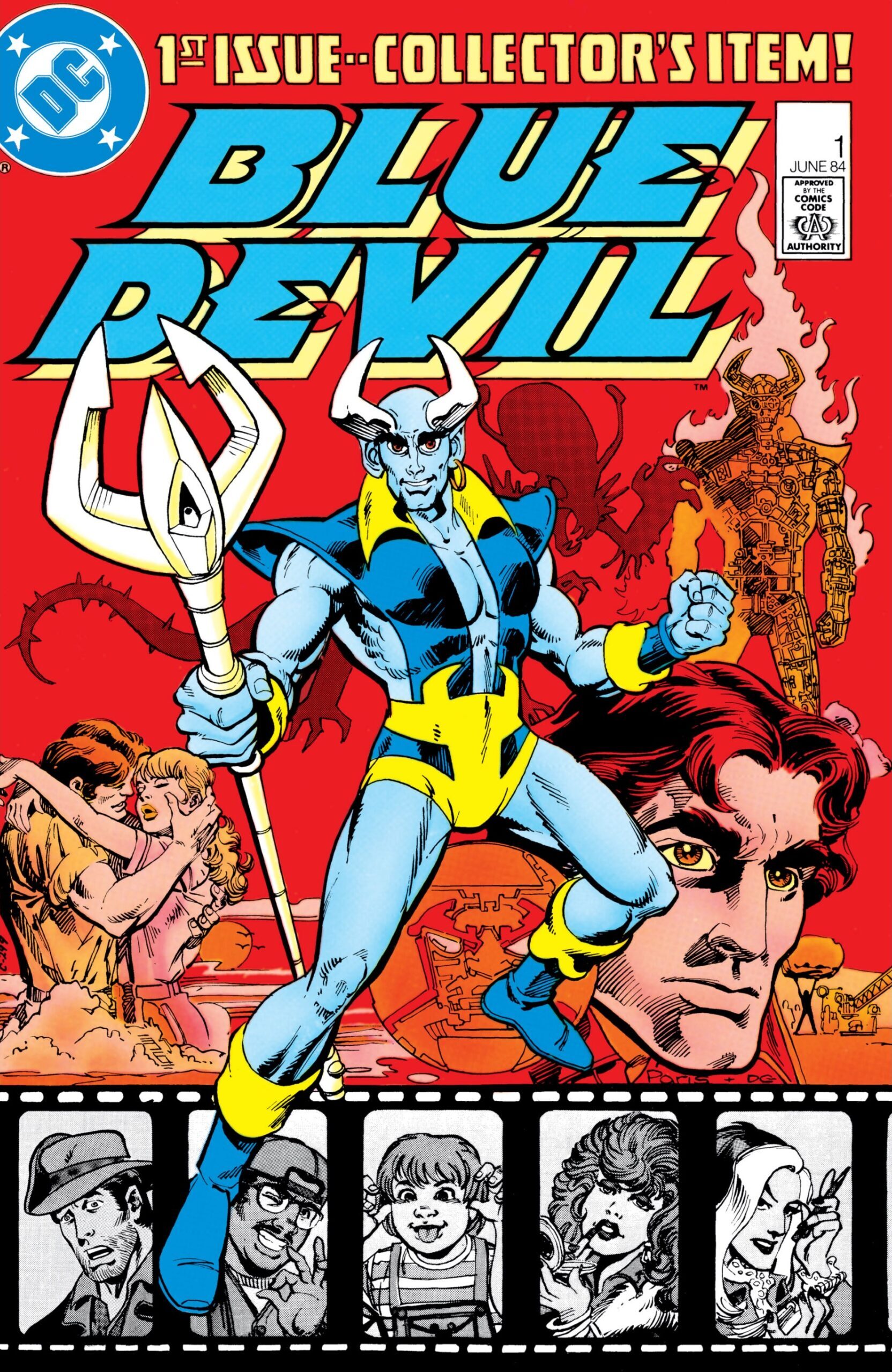
DEVIL OF A DEBUT: Of the regular writers I am encountering in this 1984 read, the one I was least familiar with is Dan Mishkin, the regular writer of WONDER WOMAN who is also a co-creator of Blue Devil, whose title premiered this month. As it turns out, a few days after I read BLUE DEVIL 1, I saw that Mishkin is active on Bluesky, and artist Matthew Dow Smith had just done a drawing of the character as part of a set of weekend commissions. (I’ve been amazed at how many times I have seen something in 2026 that makes me think of a comic from 42 years ago that I have recently read.)
Hey, remember when I said I got to draw my favorite comic book character for one of the people who created him?
This new title and character get off to a decent start, with a cast of characters and their somewhat complicated personal relationships established quickly. I realize that a 50-year-old in 2026 was not the target audience for this comic book in 1984, but when I look at the number of romantic longing subplots that had to do the heavy lifting of character work in these comics, I want to follow a bunch of these characters around with a boom box blaring Billy Joel’s 1983 hit Tell Her About It.
Paris Cullins does a nice job with the character and the action scenes, leading up the final page reveal of the central premise or hook of the character. I’m looking forward to seeing how it develops in future issues.
Blue Devil 1 Cover – Pencils: Paris Cullins – Inks: Dick Giordano
GIL TO THE GREEN: It looks like there was a glitch in the schedule and the story that DC intended to publish in GREEN LANTERN 177 wasn’t ready in time. So we get what is essentially a fill in story with a framing sequence drawn by Chuck Patton. Hal returns from last issue’s fight and gives an interview to a TV reporter, which gets him to thinking about a previous time he got into a tough fight. The flashback sequence, in turn, is drawn by Dave Cockrum. It’s a perfectly adequate story and the artwork is quite good, but the truth is that a week after I read it, I remembered the basic structure but had forgotten many of the details. This is another one of those moments that shows how 80s superhero comics were a lot like TV procedural dramas . . . the publishers needed to have a new adventure ready to roll out every month, and not all of them are going to be memorable.
These days I feel like publishers are more likely to just delay a book rather than interrupt a serialized story. When health issues slowed Jim Lee down and delayed the issues of BATMAN he was working on, DC just went months at a time without publishing BATMAN, until the renumbered BATMAN series was ready to launch. (This means DC published BATMAN 161, BATMAN 1, BATMAN 2, BATMAN 3, BATMAN 162, BATMAN 4, BATMAN 5, BATMAN 6, BATMAN 7, BATMAN 8, BATMAN 9, and BATMAN 163, in that order. Have I mentioned how cranky contemporary comics numbering makes me?)
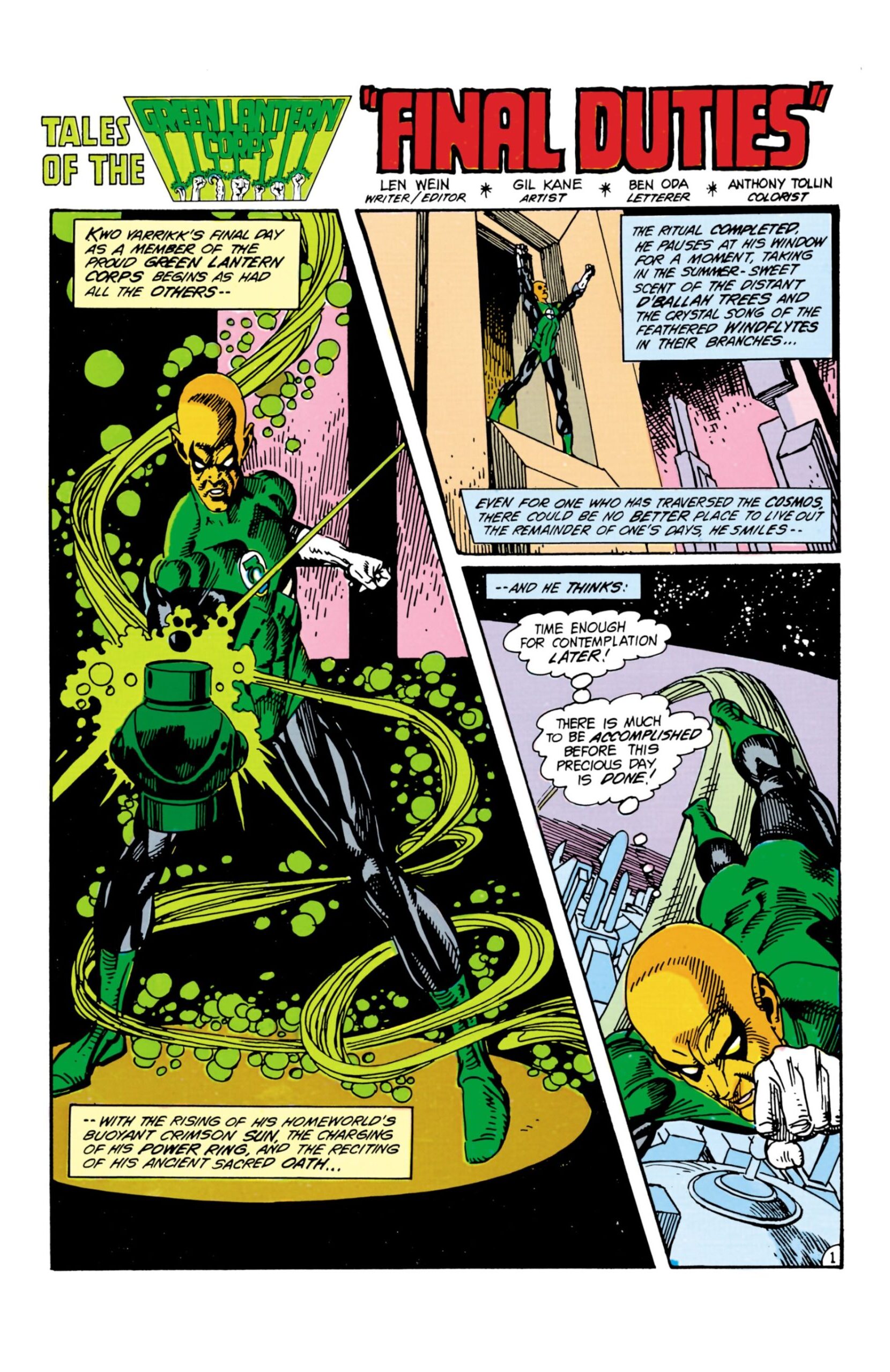
There’s also a backup Tales of the Green Lantern Corps feature, which I appreciate as a way of showing one of the 3599 Green Lanterns who aren’t supposed to be protecting Earth. This Tale in particular is cool because it has art by legendary Green Lantern artist Gil Kane, and it shows a GL on his last day on the job before he retires to hand the ring over to someone else.
Green Lantern 177 Page 18 – Writer: Len Wein – Pencils/Inks: Gil Kane – Colors: Anthony Tollin – Letters: Ben Oda
I will probably have more to say about this when covering a later month, but it is interesting to see how DC was depicting Hal and the Corps back in 1984 and compare it to what we’re seeing on TV with LANTERNS – a show I’m really enjoying, but is definitely setting its own direction.
COMICS ART IS JUST COOL: There are a couple of books this month where I don’t have much to say about the stories but some of the art was just so cool that I snapped the screenshot buttons on my iPad.
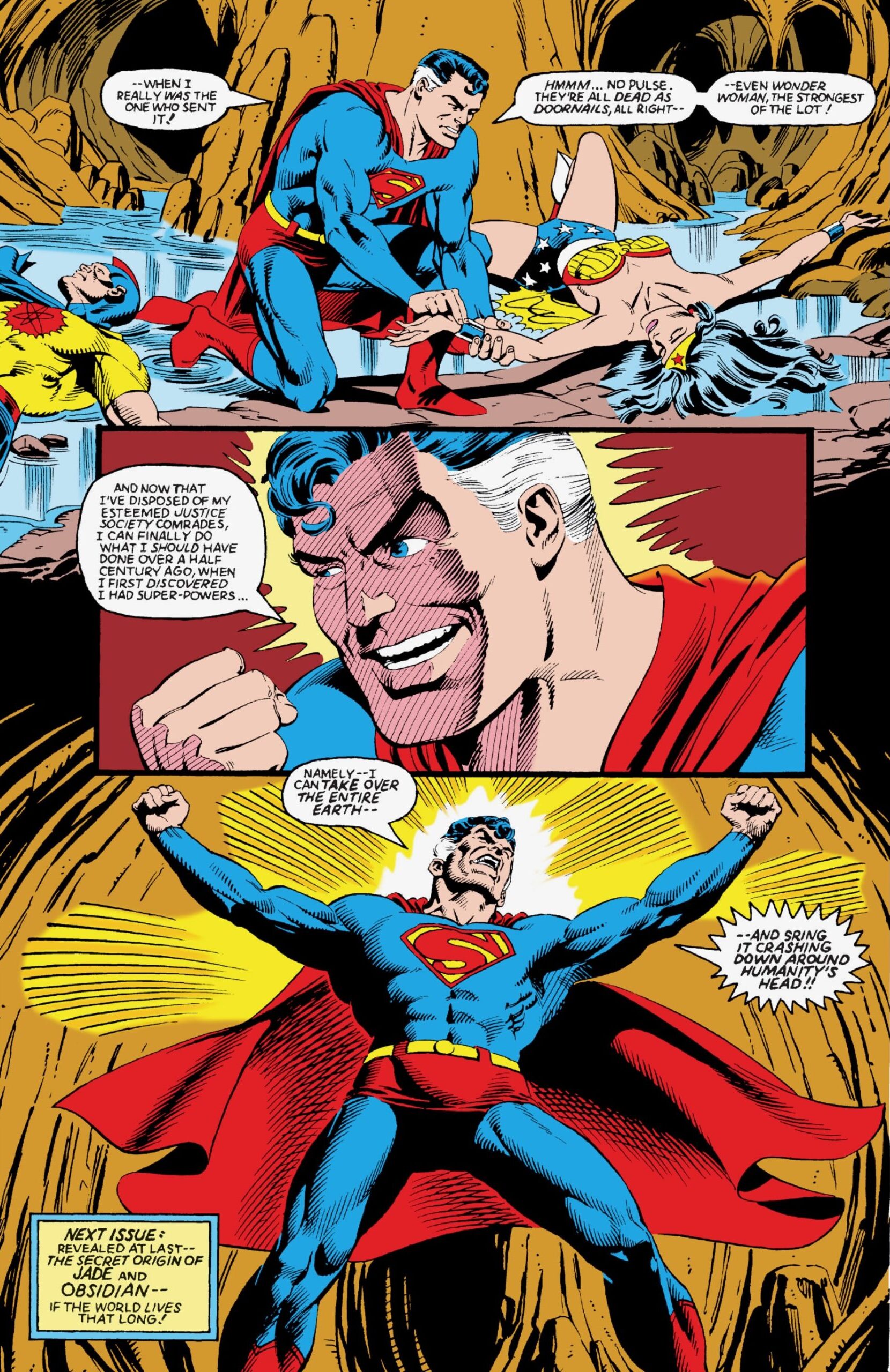
Here’s Jerry Ordway drawing the original Superman from Earth-2, albeit a little older and driven homicidally insane on a temporary basis, in INFINITY INC. 3.
Infinity Inc. 3 Page 23 – Writer: Roy Thomas – Co-Plotter: Dann Thomas – Pencils: Jerry Ordway – Inks: Mike Machlan – Colors: Adrienne Roy and Anthony Tollin – Letters: David Cody Weiss
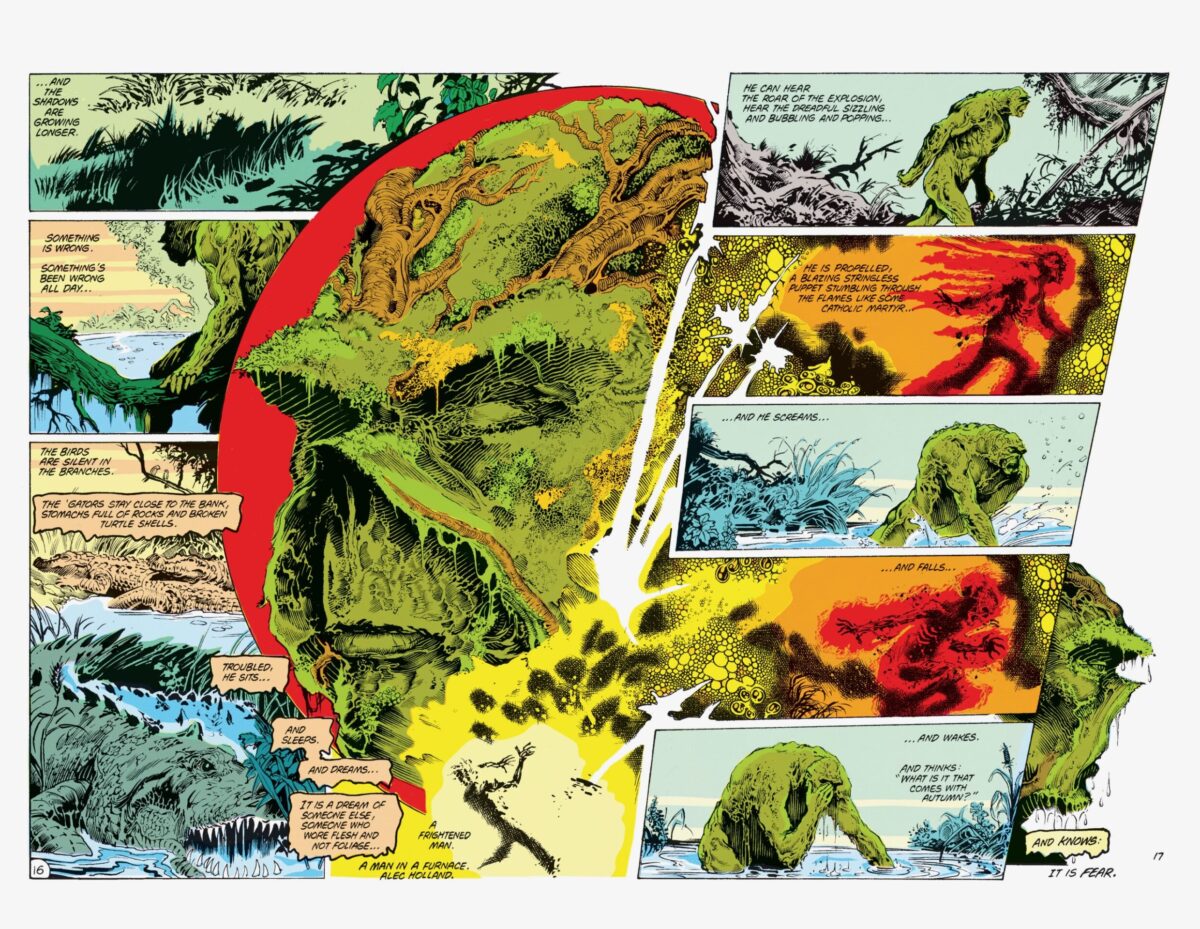
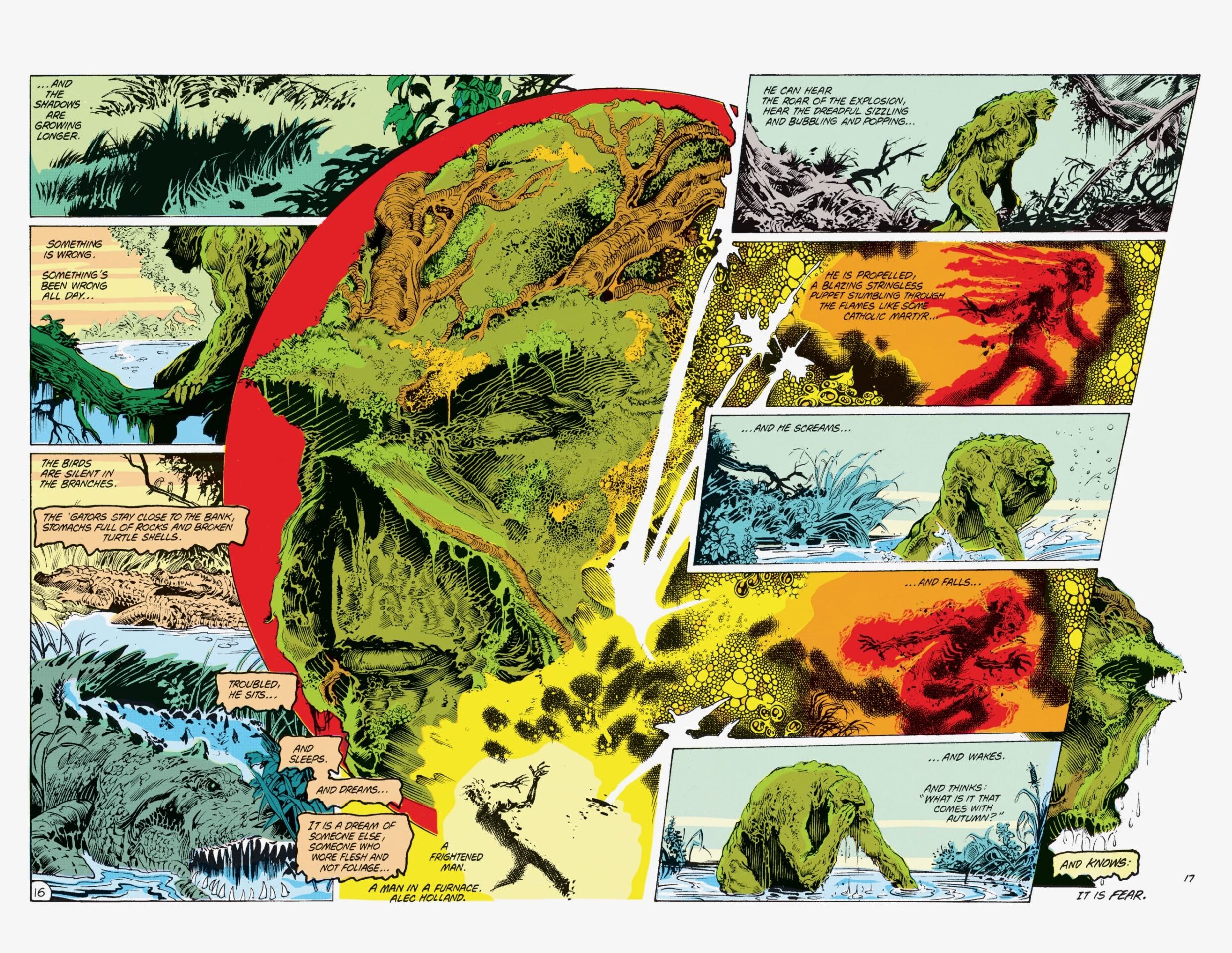
And geez, just look at what Steve Bissette, John Totleben, Tatjana Wood, and John Costanza did on this two page spread from SAGA OF THE SWAMP THING 25.
Saga of the Swamp Thing 25 Pages 16-17 – Writer: Alan Moore – Pencils: Stephen Bissette – Inks: John Totleben – Colors: Tatjana Wood – Letters: John Costanza
Comics are great. I’m gonna go read some more. Catch you soon with thoughts about April 1984.
I’m about to head back to the classroom to get ready for my 18th year of teaching high school students. This time of year puts me into a frame of mind to look back at older lessons and see what I want to tweak and revise. I have a notion to give myself some extra work this year and not just look at my civics and economics lessons for the classes I will be teaching students this year, but also to look at what I did in the years right after the worst of the pandemic when I was teaching students US history. I’m thinking I might package some of that material and post it here on my site. Maybe some teachers will find it useful. Maybe it’ll spark an interesting discussion or two. At the very least it will give me an opportunity to reflect on my work and I hope that will help make me a better teacher.
The reason I want to do this with my US history assignments is that I decided to teach the class by going backward chronologically. We started by talking about what is happening in the US right now, and then each unit went back a few years and tried to talk about some of the decisions and actions that led to the things we had already learned. I had been thinking about this approach for years and I figured, if the disruption of a global pandemic isn’t an opportunity to try an outlandish idea, what is? So I figure this is probably the class where the stuff I have done is different enough from other resources that it’s worth talking about.
Here are some of the reasons that I took the plunge and went with a reverse chronological approach.
FOCUS ON SKILLS: I think this is true for all subjects that we teach students in K-12 education, and I’m certain that it’s true in history: there is more to cover than we can ever hope to cover in one year or even four. But if we can help students develop certain historical thinking skills, we can help them develop a toolbox that they can continue to use for the rest of their lives. The specific content is useful and interesting (to me, at least) in its own right, but its most important function is to give us a space to practice using the skills.
What does teaching about more contemporary history topics have to do with this? The further back in time you go, the more abstract things get to students. (Anyone who has tried to explain to a 2020s teenager what it was like to grow up in the 1980s without a cell phone has an inkling of what I mean here.) Language in the primary documents is going to be a little different. The rhythms of daily life are not the same. What was a contentious issue then doesn’t even raise questions today. So by using more familiar materials, and then gradually showing how the past was different, students can put more of their intellectual energy into building the skills rather than translating the past into the present.
The historical thinking skills I tend to emphasize include:
establishing and understanding chronology;
identifying and explaining cause and effect relationships;
placing primary and secondary sources into context;
using evidence from sources to support conclusions;
considering how a source reflects the specific perspective of the creator(s) of that source.
LEVERAGE STUDENTS’ CURRENT INTERESTS: When I chose themes for the year, I tried to pick things that I saw students engaging with in their art projects and other activities, from technology to immigration to LGBTQ+ issues and so on. I was trying to set up a framework that would help them tell a more robust story about the world they were engaging in. Now, it’s absolutely true that in many cases, historians can tell a story about the way our modern world operates that stretches back centuries, but I feel like the closer-to-the-present stuff is often more accessible and easier for students to build their making-connections skills.
LEVERAGE MY LIFE EXPERIENCE: The thing about growing older as a teacher is that there is an ever-growing range of material that exists as lived experience for me and Stuff for the History Books for my students. And when you start teaching students about US history from 1600 or 1865, the odds you get to cover a lot of the 1990s and 2000s are pretty low. When I was in school in the 1980s and 1990s, it was a common joke that US history classes would start in colonial or pre-colonial times and then race to try to get through World War II by the end of the year.
Now, that wasn’t great even when I was a kid – I learned relatively little about the Black civil rights movement, Vietnam, Watergate, post-1960s feminism, and a host of other topics compared to, say, the US Civil War or the Gilded Age. But back then I could still pick up references to the 1960s and 1970s in popular media and I was able to pick up some things from context to cover some of the gap.
Now that gap is even wider – if a US history course wraps up around the 1960s, there’s no room to talk about the rise of AIDS, the public introduction of the Internet, the post-Sept. 11 war on terror, the 2008 financial crisis, or a bunch of other things that feel enormously relevant to me but are unknown to my students.
Absolutely, some of this is me getting older and metaphorically waving my fist at the clouds and saying “Kids these days!” along with “I’m still relevant!” But I don’t think it’s a bad idea to teach my students about things that, when they have additional questions, I have a lot of tools in the toolbox to help answer those questions.
INCORPORATE NEWS LITERACY: This part is getting a little harder as many news institutions put their archives behind paywalls (often for understandable reasons). But my curating a set of sources that were reporting on events in real time or close to it, I help introduce my students to some of those institutions and help them get practice at gathering information from a text journalism source.
INCLUSIVE TEACHING: I know teachers can and do discuss the 1600s and 1700s without only focusing on white men. But I do appreciate being able to have students learn about Congress by reading about someone like Patsy Mink or about the intersection of culture and commerce by reading about the development of Black musicians like Philadelphia’s own Gamble and Huff in the 1970s.
I taught students US history with this approach for three years, until I was reassigned to teach them about civics and economics. I would definitely enjoy using this approach again if I ever return to the subject, because I think I was reasonably successful at achieving these goals and I believe I would improve the course with further practice. But if that never happens, I enjoy the teaching I do now as well.
Despite all these reasons, there are definitely reasons to reconsider this approach, and some potential stumbling blocks if you take it on. I wasn’t the only one teaching students US History at my school, so if someone transferred between my class and a colleague’s, that person could have a bumpy ride. And if a 12th grade teacher was counting on all of their students having an identical store of background knowledge, well, I kinda wrecked that hope.
I also had to make sure I didn’t assume students already knew things that I didn’t cover. For example: if I’m going to teach students about what Congress did in 2010 before I ever get a chance to teach them about the drafting of the Constitution, I better make sure I explain what Congress does and how it works at the start of the year.
There are also people in the historical studies field who would probably criticize me for the way I’ve talked about using the study of history as a way to understand the present, rather than viewing the people of the past as people with their own lives and their own ways of seeing the world that we should try to understand and respect in their own right. I have a fairly instrumentalist view of knowledge and learning that connects with my philosophical roots in classical US pragmatism, and I know those views are nowhere close to unanimously shared. So some things that I have set out as priorities might not resonate with other educators. (I should also emphasize that even if I study the past as a way of understanding the present, the study is only going to be useful to the extent that I try to understand the people and events of the past as fully as possible, rather than assume that everyone in the past was essentially running a dress rehearsal for whatever thing I might be thinking about today.)
So I would not call this approach to teaching US history a no-brainer can’t-fail approach. But I think some teachers might find it to be a useful structure. So my goal over the next few months will be to post some of my lesson materials here on Not News, and see if it strikes up any useful conversation.
Here we go with month 2 of DC’s 1984 output, with the May 1984 cover date on books shipped in February. This is based on what I could read on DC Universe Infinite, so there are a bunch of issues missing again. Overall I’m glad I read these issues, but outside of SWAMP THING there were no home runs. Even my favorites like TALES OF THE TEEN TITANS and LEGION OF SUPER-HEROES let me down a little. A lot of DC’s books this month were perfectly serviceable but most of them are the sort of thing that I would read and then put in my long box and not think about for a long time afterward.
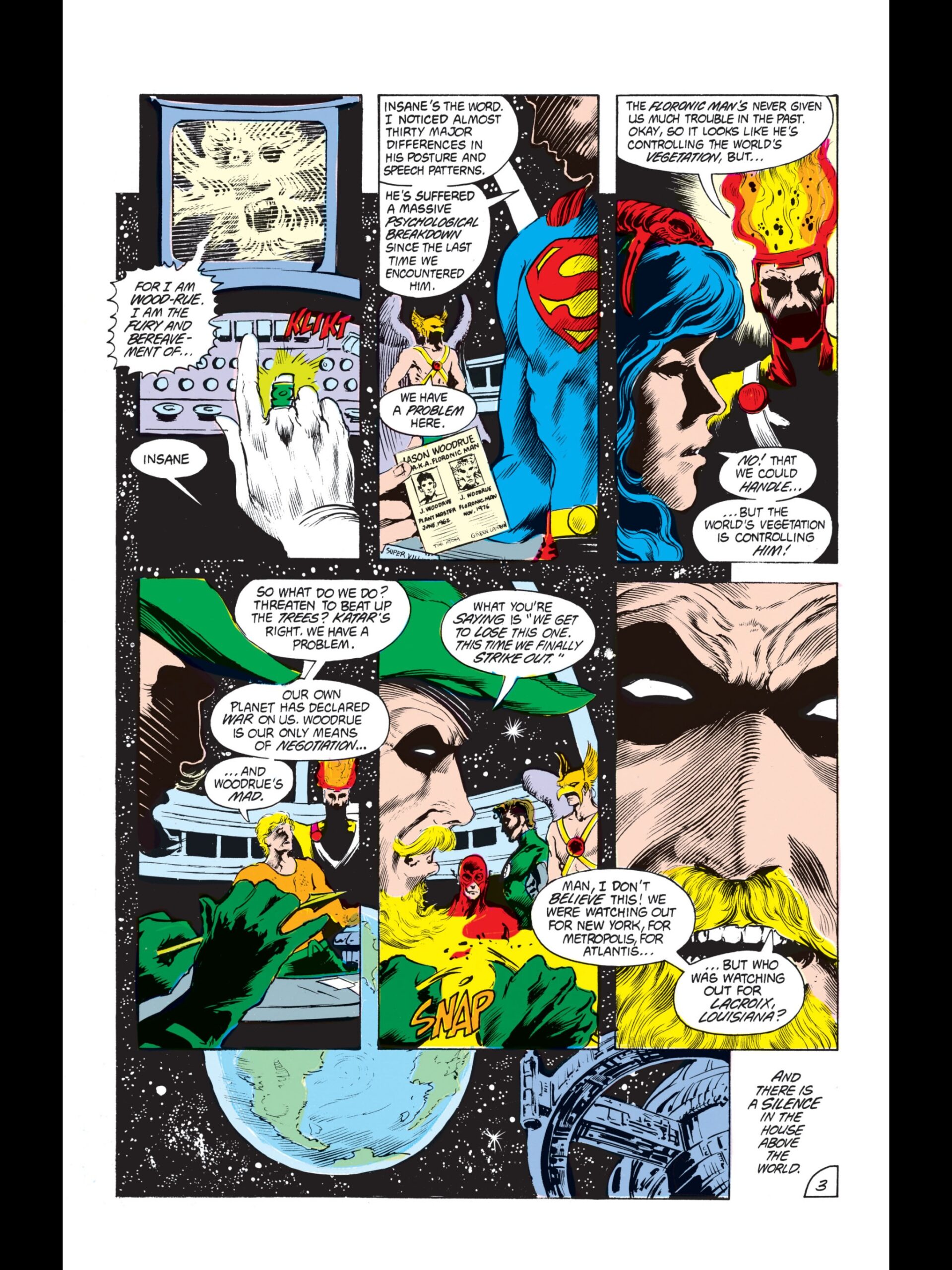
STELLAR SWAMP THING: I started reading Alan Moore’s run on SWAMP THING in trade paperback collections several years ago. I honestly don’t remember exactly how far I got. I’m happy to have jumped back into it with this reading project, that’s for sure because this work really stands out when compared to the other superhero books DC was printing at the time. This month’s issue 24 features the Justice League of America, operating in the background, remarking about how helpless they and the other superheroes are. It creates quite a mood as Swamp Thing has to find a way to reason with the world’s plant life. The artwork matches the writing thanks to Steve Bissette, John Totleben and Tatjana Wood’s work.
Saga of the Swamp Thing 24 Page 3 – Writer: Alan Moore – Pencils: Steve Bissette – Inks: John Totleben – Colors: Tatjana Wood – Letters: John Costanza
I noticed that these SWAMP THING issues in DC Universe Infinite have a “Conversion by Wildstorm” logo that I have not seen in any of the other digital issues I’ve read. It makes me wonder exactly when this conversion was done, and whether it was done specifically for digital or for a particular printing of the collected editions. I certainly think the colors work well for reading on a tablet, and I am looking forward to more.
HOW TEEN ARE THESE TITANS: I make no secret of my fondness for George Pérez’s artwork or the Teen Titans as characters. And with issue 42, TALES OF THE TEEN TITANS starts one of its most famous stories, The Judas Contract. But this first issue of the storyline focuses on the characters interacting out of battle. While that is often a strength in the series, this issue makes me spend way more time than I want to reading about the inappropriate age-gape relationships that Marv Wolfman and Pérez wrote into the book. Yes, he’s a bad guy doing bad things, but Deathstroke should lose any semblance of being a villain with a code or even an anti-hero as a result of him sleeping with a fifteen-year-old Terra.
Meanwhile, already-divorced failed professor Terry Long is in no way an appropriate match for Donna Troy if Donna is in fact a teenager. Now, I almost talked myself into giving this relationship some slack because I think Wolfman and Pérez are treating the main characters more like young adults – they all live on their own and have jobs; Donna is a successful freelance photographer. So maybe in that light the gap between Terry and her should be seen as smaller and less problematic. And then I thought about this issue having Changeling flirt with Terra and I got the heebie-jeebies all over again. I just wish such a classic series didn’t have this ick factor hanging over it.
EARTH-2 REPRESENTS: Whatever concerns folks at DC had about the multiverse being confusing didn’t stop them from publishing two books written by Roy Thomas set on Earth-2, with INFINITY, INC. joining ALL-STAR SQUADRON. On top of that, the Earth-2 Huntress had a backup feature in WONDER WOMAN. I think that once you take the “daughter of Batman and Catwoman” angle away, Huntress is a costume and crossbow in search of a character, so I’m glad to have a glimpse at the original concept here.
The problem is that I think I like the concept of Earth-2 – a world where in 1984 superheroes had been around since World War II – more than the execution in these books. Especially the first two issues of INFINITY, INC., where characters barge into a room to demand that the Justice Society of America listen to them and then get upset when the barged-upon characters are a little cranky about it. Even in 1984, there were comics with better dialogue and characterization than this.
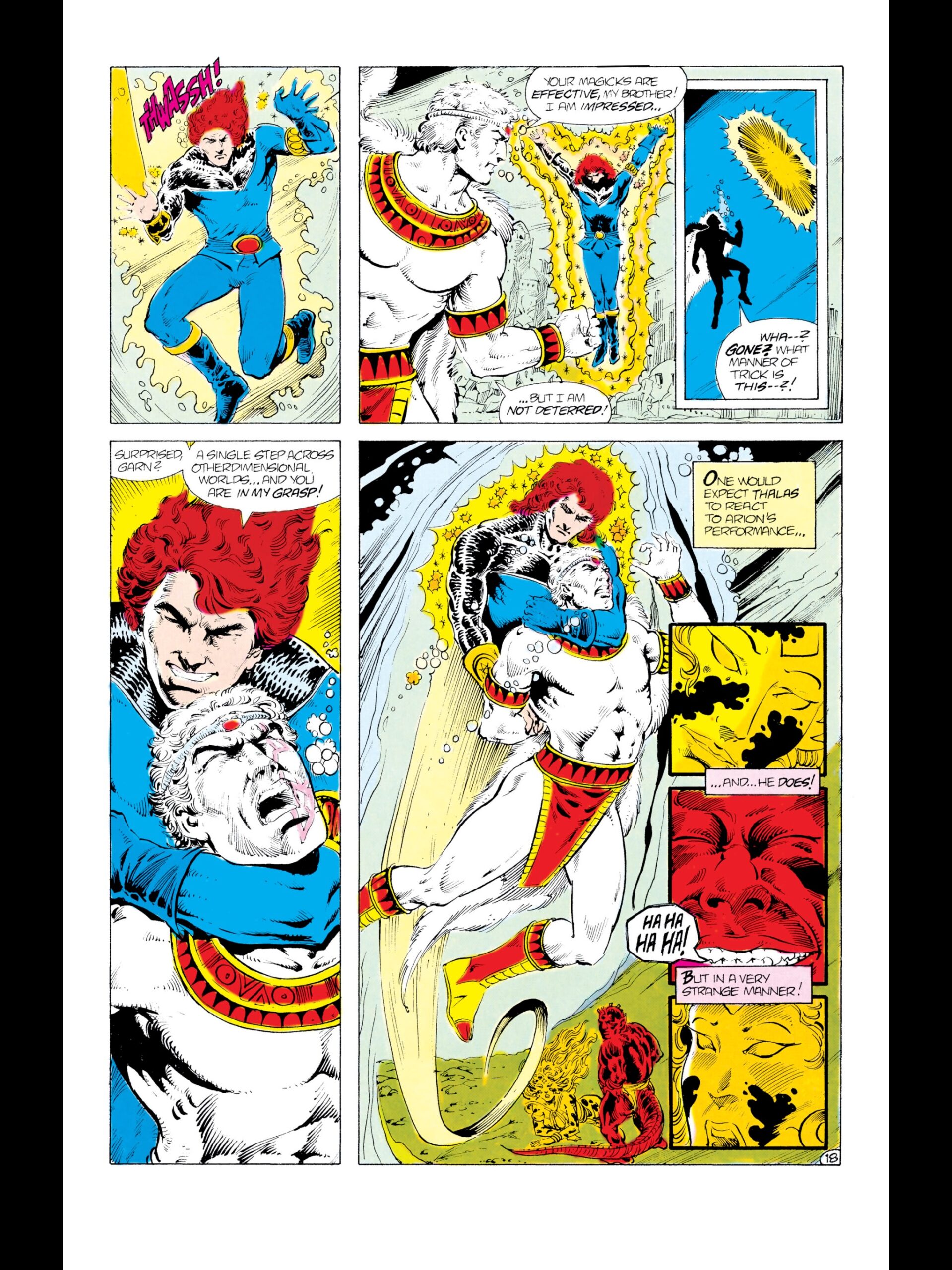
FAVORITES MAKE SOME EARLY APPEARANCES: That said, INFINITY, INC. has artwork by Jerry Ordway, who would go on to work on some of my favorite issues of the Superman books in the 1990s. And ARION, LORD OF ATLANTIS 19 has work from Jan Duursema, who did some great work on Dark Horse’s Star Wars titles in the 2000s. It’s nice to see their work in these early issues. I admit, two issues in to my read, I am still trying to figure out exactly what’s going on in ARION – this is probably the character I am least familiar with, and it seems like Duursema and writer Paul Kupperberg have already built quite a bit of lore in the 17 issues I missed. Of course, today I don’t even have to hit the back issue bins if I want to go back and get into the series from the beginning – I would just have to hit a few buttons on my app. I’m kind of interested in seeing how much I can figure out as I go, though.
Arion Lord of Atlantis 19 Page 18 – Writer: Paul Kupperberg – Pencils: Jan Duursema – Inks: Rodin Rodriguez – Colors: Bob LeRose – Letters: Andy Kubert
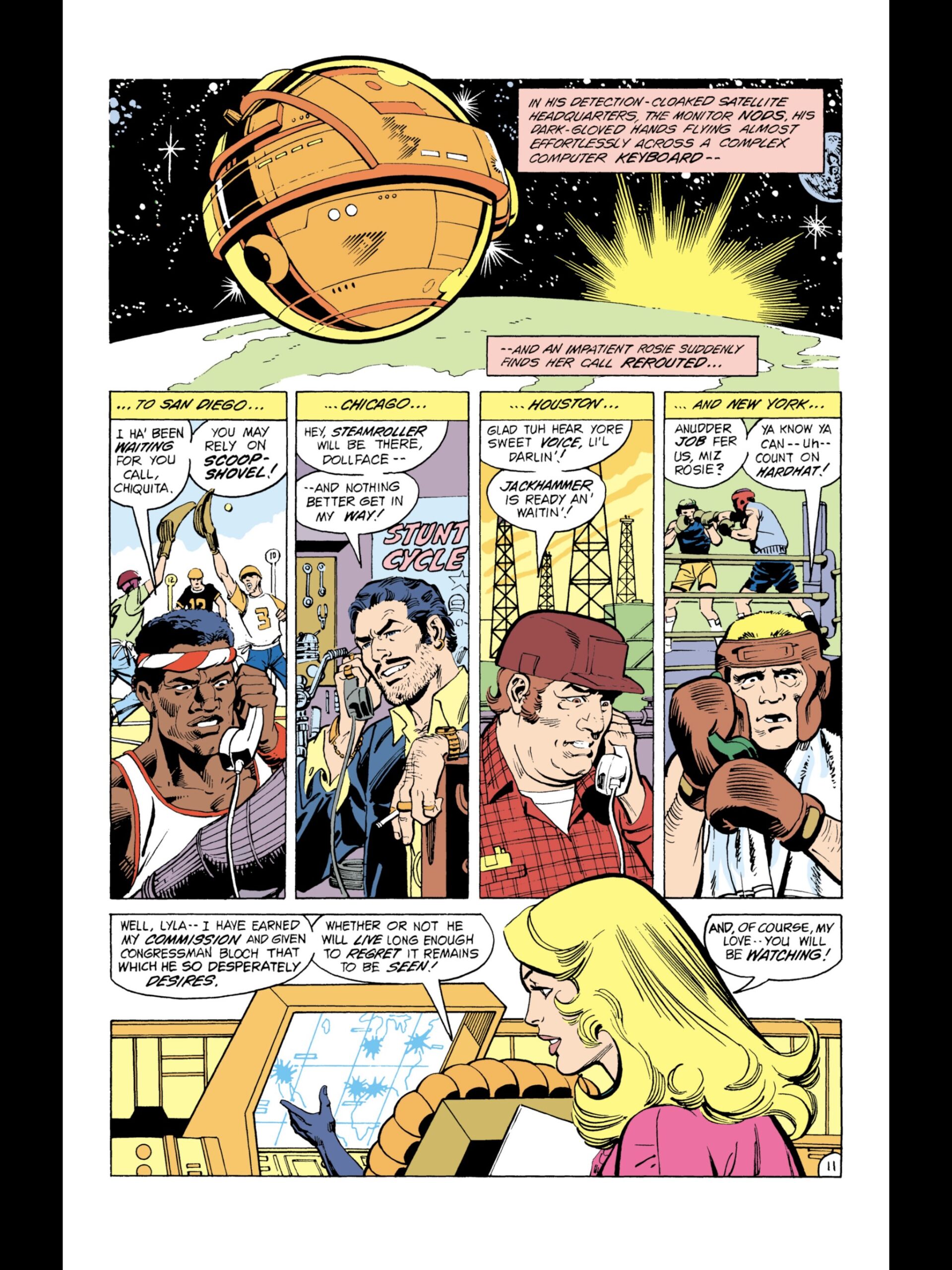
MONITOR MENTIONS: 1984 is the last year before all hell breaks loose for DC, but even early in the year you can see the storm clouds gathering. This month sees two mentions of the Monitor, including an extensive scene in GREEN LANTERN 176 written by Len Wein, who helped to edit CRISIS ON INFINITE EARTHS. The other mention comes in VIGILANTE 6, written by Marv Wolfman. So it’s the folks who were at the center of the planning trying to work in these appearances – which would wind up not quite fitting the more benevolent Monitor who would show up in CRISIS issue 1. But that’s the risk you take when you try to build your reboot plane while the publishing line is still flying.
Green Lantern 176 Page 11 – Writer: Len Wein – Pencils: Dave Gibbons – Inks: Dick Giordano – Colors: Anthony Tollin – Letters: Ben Oda
BAT BOOKS DELIVER: Doug Moench delivers another two part caper in BATMAN 371 and DETECTIVE COMICS 538 that also keeps the subplots moving smoothly. I love this pacing, where you get a complete story in one month but there is also time for characters to evolve a little. I love the characterization of a much healthier Bruce Wayne and Jason Todd. These books are right in a superhero sweet spot for me. So far, of the books I’m reading for the first time, BATMAN and DETECTIVE are the two titles where I like the 1984 status quo better than what I found when I started reading in 1989.
One thing that happens to me now that I am in my fifties is every once in a while, I stop and look around and realize that that something that was a fundamental building block to how I navigated the world is just gone now, and there are successful, functioning adults who have no idea that the world was once different. I saw one thread on Bluesky with people wondering how anyone ever used paper maps to navigate!
Now, at one level, this is just the natural progression of things. I’m sure that in 2000 there were people thinking the same things about my cohort, and in 2050 today’s 20somethings will be thinking them about a new generation. But there’s one aspect of this that I think deserves more attention. I think a lot of the things we’re losing are because in many cases the balance has gotten out of whack between what I’ll call the Fervent Followers and the Causal Audience.
(Note – I will freely admit that I have been thinking about this post for months and one of the things that has held me up is trying to come up with a name for what I’m talking about. I’m still not sure I have done a good job with that but darn it I am going to write this darn thing.)
I don’t think it’s controversial to say that for any popular thing, there is a larger group that thinks the thing is perfectly fine and a smaller group that is much more intense in its interest. I was writing about that years ago. But what I have started paying more attention to is that it’s not just the smaller group of Fervent Followers likes the thing more than the larger Casual Audience. Often, the Fervent Followers like the thing for completely different reasons – sometimes reasons that come into conflict with the Casual Audience!
I’m not nearly as invested in sports as I used to be, but baseball has probably been the sport I have paid the most attention to over the years. One frequent discussion is about the value of the regular season vs. the playoffs in Major League Baseball. The MLB season has 162 games, which provide teams with ample opportunity to demonstrate their strengths and weaknesses. A playoff series contains between 3 and 7 games, which is a much smaller sample size, and allow for frequent fluky results.
A lot of diehard baseball fans hate this about the playoffs, and they hate that the playoffs have expanded to allow more teams to participate – thus increasing the chances that a team that was inferior through the full season will defeat a team that did better. But in part because of that possibility, and because the smaller sample creates less margin for error, much of the audience finds the playoffs much more dramatic. They pay much more attention to the playoffs than the regular season, and so Major League Baseball has tried to create more playoff baseball to satisfy this Casual Audience.
In the process, they have made the regular season less intense, because teams don’t put as much pressure on themselves to win their division because they are confident they will make the playoffs regardless. This makes the regular season that the Fervent Followers value less appealing to them, because they don’t see pennant races like 1993’s National League West, where a San Francisco Giants team that won over 100 games missed the playoffs because the Atlanta Braves won even more.
This tension always exists and creators have to figure out how to balance the interests of the Fervent Followers with those of the Casual Audience, because both are important. But I think that what’s accelerating today is that technology is making it easier to create products that are more narrowly tailored, so that they let the Casual Audience get what they care about without the parts that the Fervent Followers care about. And then the Fervent Followers aren’t a large enough market by themselves to support the thing that they appreciate, so producers stop creating or distributing the thing that satisfies them.
We can see this when we look at movie theaters. There are definitely still people who care about the unique and special experience of watching a movie in a theater. Over the last two weeks we’ve seen stories about the great lengths some people are going to in order to see Christopher Nolan’s The Odyssey in 70mm IMAX. Nicole Kidman has been congratulating us for spending money to enjoy having our heart broken for years now. The Fervent Followers are far from non-existent!
But even those stories point to the problem. There are only a couple of dozen places in the US to see The Odyssey in 70mm IMAX because all of the projectors are 50 years old and no one has figured out how to make it worthwhile to design and build new ones. AMC certainly doesn’t have the money to build hundreds of auditoriums to hold giant IMAX screens. They’re busy advertising to the audience that already bought a ticket so they’ll feel good enough about the purchase to maybe do it again!
The data shows the problem. In the 1930s people bought so many more tickets to movie theaters than they do today. I see a claim in the Los Angeles Times that people bought 80 million tickets a week – more than 4 billion a year! (That number seems absurd to me and I can’t see where the Times got it, but I haven’t been able to find a number I feel more confident in.) In North America we haven’t cracked one billion since the pandemic, according to Statista.
What’s happened? Well, over the 90 years, we have seen wave after wave of technological innovation that allowed parts of the Casual Audience to get what they like without having to go for the full-blown celluloid cathedral experience. Television. Cable. VCRs. Widescreen HDTVs. Tablets. Smartphones. People who just want to watch a story – or even half-watch a story while they think about something else – now have so many more options.
“The movies” as something distinct from streaming video programs and short-form social video content is becoming increasingly more niche, ever more dependent on a smaller group of Fervent Followers. And that group is large enough to sustain things like a handful of mega budget blockbusters and smaller niche independent projects like this summer’s Obsession and Backrooms. But it’s not able to sustain the quantity or diversity of films that the ticket-buying audience supported 25 or 50 or 100 years ago.
And that’s often not just a problem for the Fervent Followers. Yeah, the Casual Audience’s primary wants are satisfied by the alternatives they’ve chosen. But while I understand the economic logic of creating new, more specialized products to give people what they want without having to pay for things that they value less or may not even want, there is a downside. The Fervent Followers are likely to invest considerable time, money, and effort into evaluating and appreciating the product. Creators who are trying to balance appeal to both audiences will make an effort to include elements that satisfy the expectations of this group, and that will often create a richer product that brings benefits to the Casual Audience even if that audience wasn’t looking for those benefits.
Imagine that Major League Baseball completely eliminated the regular season and just made a tournament of short playoff series. Yes, every game would have the drama of high stakes. But you’d have a much lower chance of series between good teams that have been tested by the regular season, and the atmosphere of the games would probably be less exciting without fans who have invested months into following these players.
A more realistic example is what’s happened to local newspapers over the last 25 years. The Casual Audience wanted the classified ads, the sports scores, the TV listings, the stock prices, and so on. So they bought a product that had those things plus more extensive reporting, analysis, criticism, and so on that had a Fervent Following but wasn’t the primary appeal to most of the customers. And since the newspaper was already there, maybe the Casual Audience would look at the headlines or read a story or two, which was a nice extra benefit.
But now that technology means people can get the ads or the scores or whatever directly, they don’t buy the newspaper. Not only are they not getting the spillover benefits, the Fervent Followers aren’t getting what they care about either, because they can’t bear the full cost of generating all that reporting, analysis, criticism and so on. Almost everybody is worse off because the largest chunk of the audience is able to get exactly what they want and nothing more.
This kind of change is inevitable, and I’m not saying we should stifle progress or not create new products because it will make older ways of doing things outdated. But I think we need to pay more attention to interdependence so that we can be more ready for the consequences when one part of an interdependent system changes substantially. I think technology is increasing our ability to optimize, and we often rush into that optimization without thinking about the consequences and how we might want to mitigate them. As I was writing this piece I started thinking more and more about the importance of bundles, so much that rather than make it one part of this piece, I want to spend more time thinking about it as a topic in its own right.
But an important place to start is understanding that so many of the things we use and experience are in fact a bundle – not a single product, but a combination of things that appeal to different audiences. And it can be very helpful to take a minute from time to time to think about how the group that you are not part of is experiencing the thing in a very different way than you are. And that difference may be a vital feature, not a problem to be solved by more specialization.
Let’s talk about DC Comics published in January 1984, cover date April 1984. I’m not going to do issue by issue roundups here (unless I get feedback that people would want to read such a thing), but rather I’ll try to comment on general themes and observations. (See the Intro post if you want to know why I’m doing this series.)
WHAT WAS MISSING: This is not a criticism of the DCU Infinite app – it’s a tremendous value that gives you access to a huge and growing library at a price so low I sometimes feel guilty. But there are gaps in what it includes, either because DC hasn’t created digital files or because they just haven’t seen fit to include it, I wasn’t surprised that titles like ATARI FORCE and STAR TREK weren’t there, but I was surprised that the April 1984 issues of SUPERMAN, NEW ADVENTURES OF SUPERBOY and THE FLASH were not. (I couldn’t find any issues of the following titles: BLACKHAWK, GI COMBAT, SGT ROCK, NEW TALENT SHOWCASE, or ARAK, SON OF THUNDER; THE WARLORD #180 was also missing.)
SO MANY WORDS: I don’t know if I have the patience or time to do a more systematic study of this, but between thought balloons, third-person omniscient narrator captions, and expository dialogue, most of these comics just flat out had more words in them than the issues I’m reading from the 2020s. Granted, Roy Thomas in ALL-STAR SQUADRON #32 does a lot to up the total, but even the average issue does a lot more telling of the story. Len Wein uses the narrator captions in GREEN LANTERN #175 to establish a newspaper as a framing/transition device, for example. You don’t really see the writer address the audience directly like that these days.
SHORTER STORIES: A lot of these books had stories that wrapped up in one or two issues, like they were episodes of a procedural drama rather than an ongoing serialized storyline. SUPERGIRL #18 has an antagonist that Supergirl dispatches by the end of the issue and is never seen again, and I’d say at least a quarter of the book is given over to a relationship subplot that’s already in progress. FURY OF FIRESTORM #22 works a one-issue recap of Firestorm’s origin into a rooftop conversation.
For comparison’s sake, I took a look at two modern books I have been meaning to catch up on – Tom Taylor and Mikel Janin’s first story in DETECTIVE COMICS was seven issues long, and the next issue of Mark Waid, Dan Mora and Tamra Bonvillain’s BATMAN/SUPERMAN: WORLD’S FINEST kicked off a four-issue arc. With that many issues to tell a story, you can use fewer panels, and you can spend time on each step of the back and forth between protagonist and antagonist. At the same time, a reader needs to invest months into watching Batman solve a single case.
Now, in January 1984, Paul Levitz and Keith Giffen were finishing up the four-issue “Omen and Prophet” arc in LEGION OF SUPER-HEROES, and Marv Wolfman and George Pérez were about to start the four-part “Judas Contract” in TALES OF THE TEEN TITANS. And there are probably done-in-one stories today that I miss because I am not reading every book that comes out in a given month. But I definitely feel like the base unit these days is more often “an arc” than “an issue,” and I get the opposite vibe from 1984.
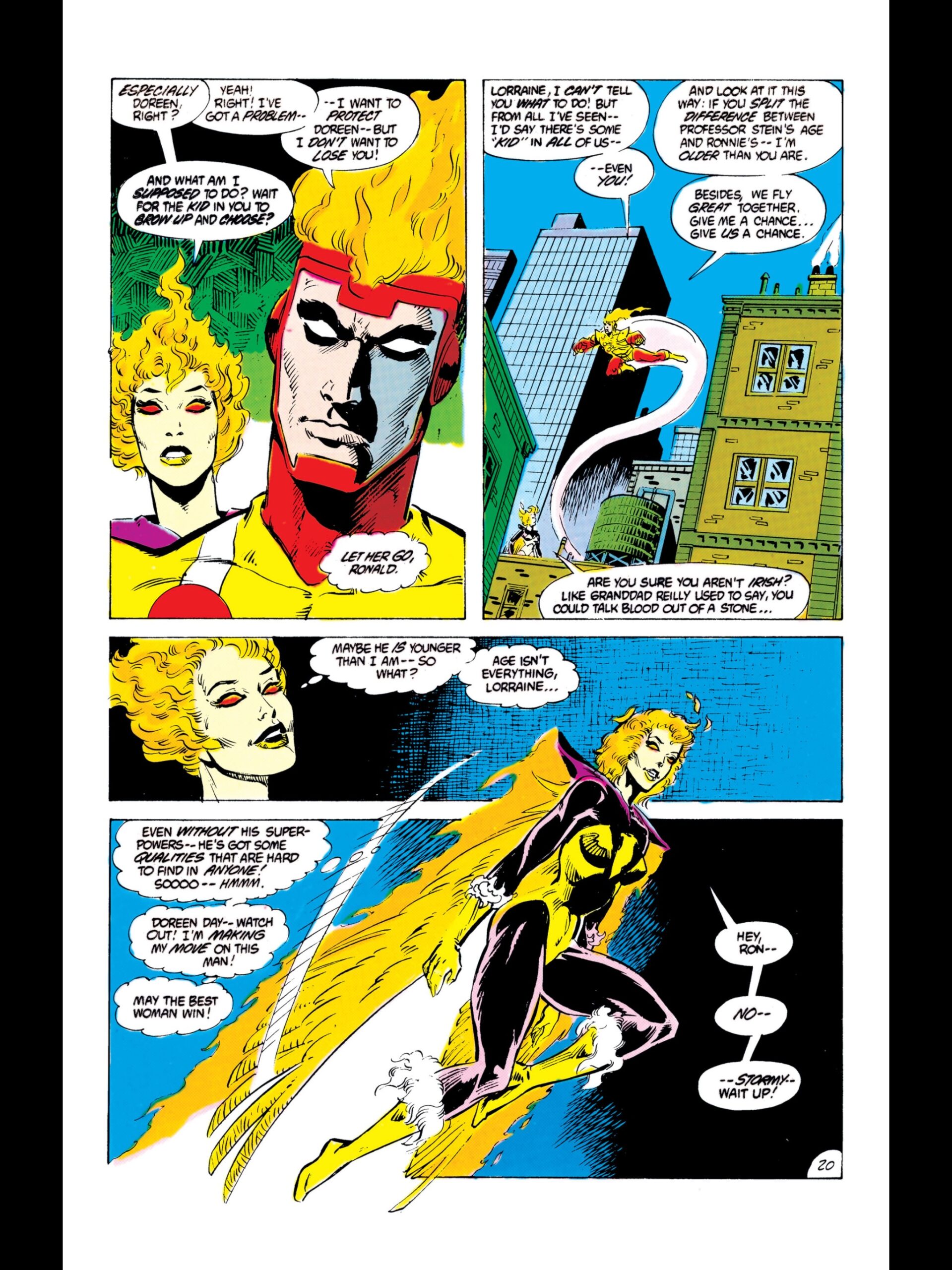
BROADER STROKES: I think because many of the stories were shorter, writers felt the need to push emotional beats to develop and resolve quickly, with characters making intense, dramatic statements and then dispensing with resultant conflicts very quickly. I noticed this most prominently in issues of JUSTICE LEAGUE OF AMERICA and FURY OF FIRESTORM written by Gerry Conway. That rooftop conversation in FURY OF FIRESTORM either advances or resolves a love triangle – I’ll find out in subsequent issues.
Fury of Firestorm 22 Page 20 – Written by Gerry Conway – Pencils by Pat Broderick – Inks/Embellishment by Sal Trapani – Colors by Carl Gafford – Letters by John Costanza
BAXTER BEGINS: I read two issues printed in DC’s Baxter format, which used better paper in order to show more detail and allow for better color reproduction than newsprint. (Shout out to colorists, by the way, and I’m gonna have more to say about that in future roundups.) These books were sold exclusively to comic shops in the direct market and did not bear the seal of the Comics Code Authority, so among other things, they were able to have a different and more mature tone than the rest of the line.
OMEGA MEN is a series I had read before, and reading issue 13 again here reminded me of how surprised I was by how bleak that series was in the way it showed violence and oppression, and how lonely the struggle against it can be.
Meanwhile, VIGILANTE brings the 70s/80s attitude that the system is broken and can’t keep people safe to superhero comics, as a former district attorney takes it upon himself to take out the bad guys. On the one hand, this feels like a weird theme for superhero comics, since most of the characters already are people who take the law into their own hands. But even in 1984, writers were grappling with this – just in this month’s issues, the Legion has friction with the Science Police and the United Plantes government, and Supergirl talks about how the United Nations has authorized her to enforce the law and protect the people. So I guess there’s a place for a book like VIGILANTE, where the characters don’t even want the approval of the system.
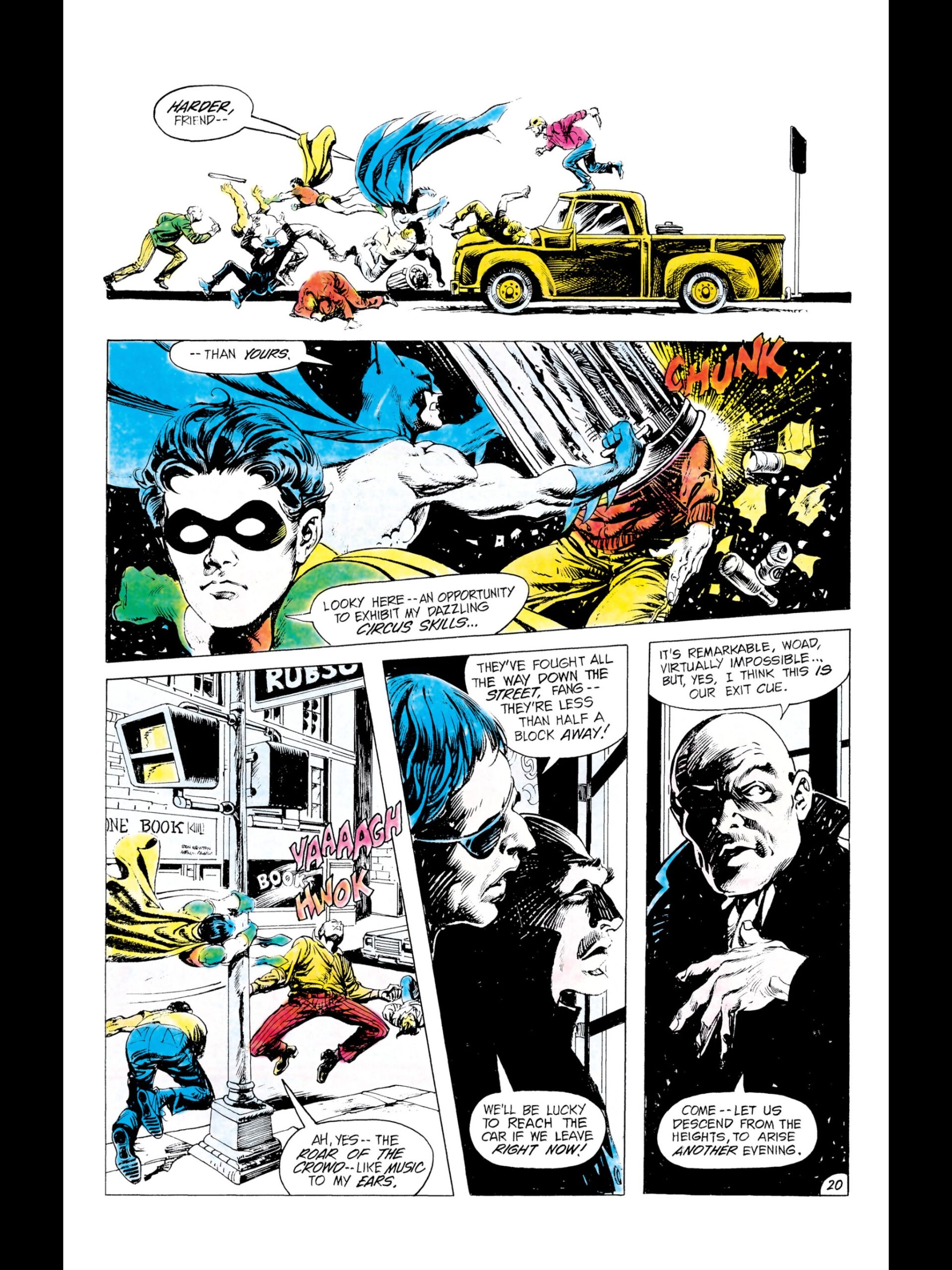
BATMAN IS IN GOOD SHAPE: Doug Moench was writing both BATMAN and DETECTIVE, and his skill plus the general approach to characterizing Batman before Frank Miller changed the game with YEAR ONE and THE DARK KNIGHT RETURNS really works for me. Don Newton and Gene Colan do a great job with the pencils of these issues, and I was fascinated by the coloring on BATMAN #370. It reminds me of watercolor paints, and there’s so much white space. It’s so unlike these other issues that I would love to compare the DC Universe Infinite version to the original printed issue to see if they look alike. Whatever the case may be, I liked the effect.
Batman 370 Page 20 – Written by Doug Moench – Pencils by Don Newton – Inks by Alfredo Alcala – Colors by Adrienne Roy – Letters by Ben Oda
We see the first, pre-CRISIS version of Jason Todd stepping into action as Robin (having received the blessing of Dick Grayson in an earlier issue that I snuck into this reading pile). Bruce has a level of humanity and emotional maturity that he too often lacked in the 90s. Gotham feels like a city that has its challenges but isn’t hell on Earth. He’s leading a team in BATMAN AND THE OUTSIDERS and he even gets to reconcile with Superman in a backup story in WORLD’S FINEST #302. There’s a reason I usually use the Bronze Age Batman costume when I’m playing LEGO BATMAN: LEGACY OF THE DARK KNIGHT. I like this interpretation of the character a lot.
SUPERMAN NOT SO MUCH: It’s hard to feel as optimistic about Superman at this point. Granted, there were two Superman-related books I couldn’t read because they aren’t in the DCU Infinite library, but that’s a point of concern in itself – it would seem there hasn’t been enough demand to reprint or digitize these stories. And the stories I did read in DC COMICS PRESENTS #68 and ACTION COMICS #554 didn’t really get me excited about the character. Now, DC COMICS PRESENTS is a team up title, so maybe Gerry Conway was more focused on exploring Vixen than Superman. And ACTION COMICS this month was a fairly simplistic tale from Marv Wolfman paying homage to Jerry Siegel and Joe Shuster and the concept of Superman more than the character. So maybe I’ll have a better impression in subsequent months.
WINNERS AND STILL CHAMPIONS: The two series from this era that are huge chunks of my back issue collection are TALES OF THE TEEN TITANS and LEGION OF SUPER-HEROES. They were some of my first glimpses of pre-CRISIS DC and their reputation is well-deserved.
Paul Levitz on the Legion is a master of juggling the huge cast and all of their relationships and subplots while creating knock-down drag-out super-battles. He made the 30th Century a rich setting with political and cultural conflicts that the Legion needed to navigate. Keith Giffen is a hugely talented writer himself, and during this era his pencils still have a more traditional look that I prefer to his later, more stylized work.
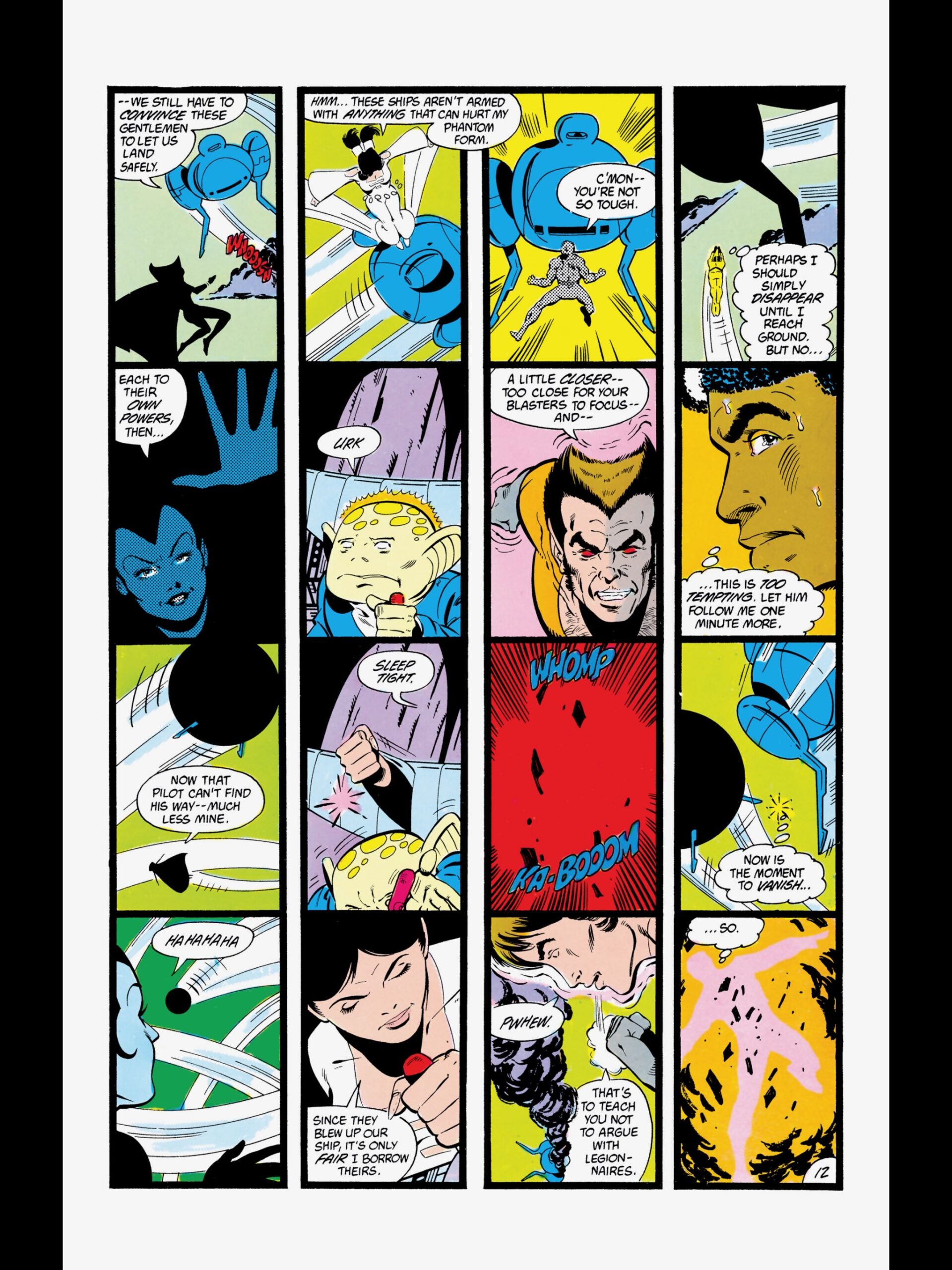
And boy, did the storytelling in the Legion need to be dense to carry all of that material. Never mind the nine-panel grid – look at Giffen saying F it, we’re doing sixteen panels. (This page is actually from the first part of the Omen and Prophet Arc – I did go back to read the whole thing rather than jump in on part 4.)
Legion of Super-Heroes 307 Page 12 – Script by Paul Levitz – Pencils by Keith Giffen – Plot by Levitz and Giffen – Inks by Larry Hahlstedt – Colors by Carl Gafford – Letters by John Costanza
Of course, if you’re going to talk about detail in comics storytelling, the master George Pérez was at work in TALES OF THE TEEN TITANS. I think his 1980s work is my favorite of his long career – he was certainly excellent from the 1990s through the 2010s, but the 80s was the perfect mix of detail and an open, graceful quality for me. This issue has several short battle scenes leading to a conclusion where the power of love and friendship (and energy bolts) saves the day. And boy, does Pérez sell every bit of it. Before I finish this review of 1984 I’m pretty sure I’ll wind up re-reading the whole original Wolfman-Pérez NEW TEEN TITANS run. But for now, that’s a wrap on January 1984.
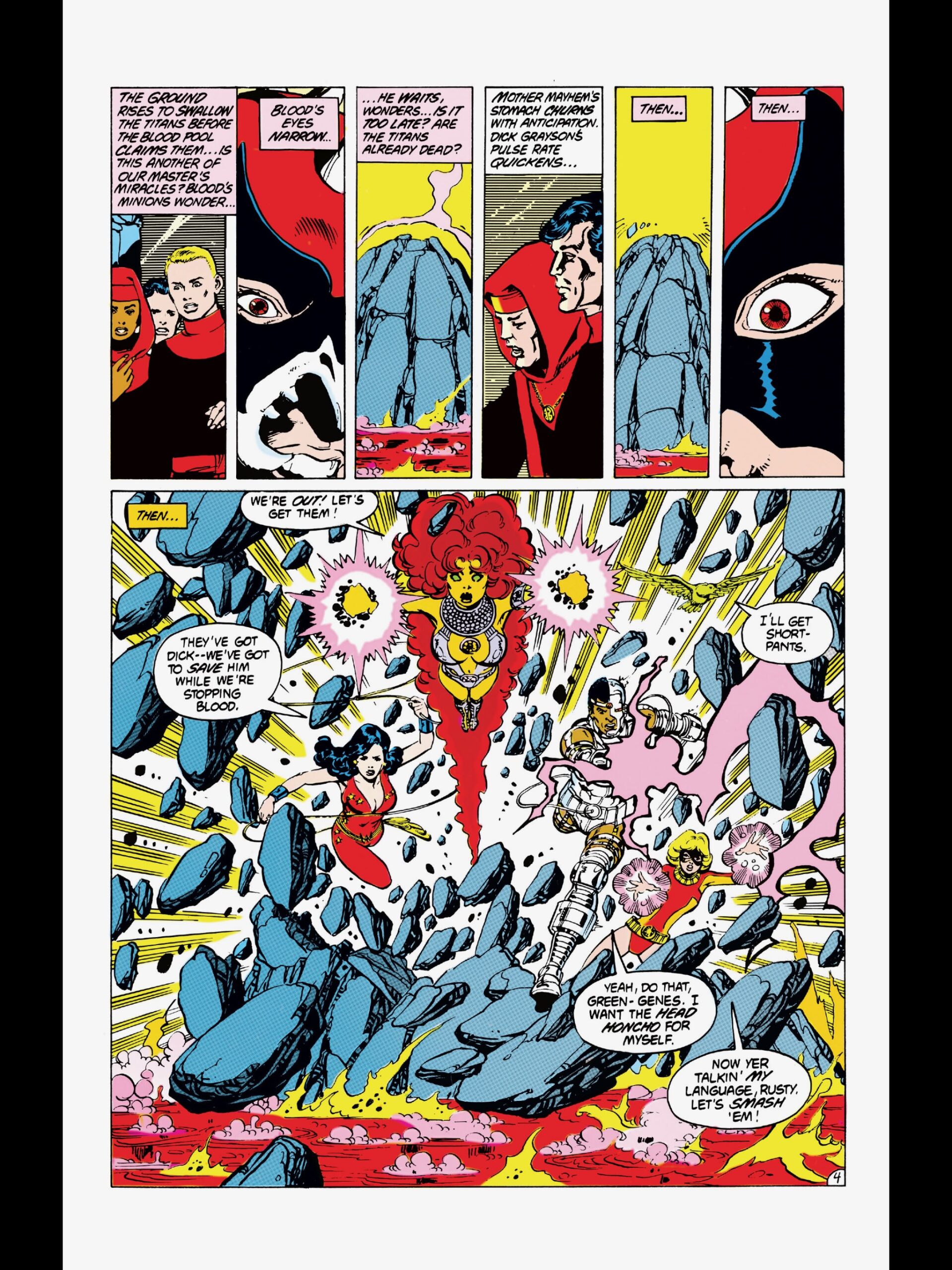
Tales of the Teen Titans 41 Page 4 – Written by Marv Wolfman – Pencils by George Pérez – Inks by Romeo Tanghal – Colors by Adrienne Roy – Letters by John Costanza
This is a bit of a pet project that I’ve been meaning to start for a while now, and Adam Mallinger gave me the final nudge to get moving on it when he started his Superfan XL site that discusses the post-Crisis Superman stories from the 80s and 90s. I am going to read as many of the comics that DC published in 1984 as I can – a task made much easier by the DC Universe Infinite app – and sum up my thoughts here, with one post dedicated to each month.
Why?
First and foremost, 1984 is the year before DC overhauled its continuity with the CRISIS ON INFINITE EARTHS maxiseries. I started regularly reading comics in early 1989, so the “post-Crisis” DC was my primary reference point. At the same time, the late 70s/early 80s versions of the characters influenced many of the spinoffs and merchandising that introduced me to the characters when I was a kid, so even if I didn’t know those stories, I feel a connection to that time period. So I want to try to get to really know the specific status quo that DC felt needed to be massively disrupted.
Second, I want to do some intentional thinking about how superhero comics storytelling has changed. The decline of newsstands and the rise of the direct market in the 1980s led to experiments with format and technique that I think turbocharged the usual evolution and development of the art form. 1986 is often noted as a pivotal year that included stories like WATCHMEN and THE DARK KNIGHT RETURNS. I want to look back a little earlier and see how those experiments were unfolding. So I’m going to be comparing 1984 both to today and to the late 80s/early 90s when I was an avid reader and purchaser.
Third, tying into the first two points, when I am done, I may want to indulge in a bit of an Elseworlds-type creative exercise and ask myself what kind of stories DC could have told if they hadn’t gone ahead with CRISIS ON INFINITE EARTHS. If nothing else, such an exercise could make for a heck of a roleplaying game setting.
So far this has been a lot of fun. So let’s get started.
I’m gonna start this off with some disclaimers because I do not want to appear like I am setting myself up as The Guy Who Is Doing Everything Right and everyone else in US education is Doing It Wrong.
I am not criticizing my colleagues or anyone currently teaching students in the classroom.
I am not criticizing my students. Heck, I am not criticizing any students anywhere in the world.
I am not criticizing the administrators of the school where I teach students or anyone in the day-to-day work of running a school.
What I am doing is trying to point out some trends in education, technology, culture, and politics that have carried all of us to a certain point. I am talking about some things that I have noticed in my own practice. And I am inviting anyone who is reading this to think about how we can be intentional about changing our systems to help take us to a better place.
We are in the midst of a crisis in reading and literacy that is part of a wider crisis in attention in a world that is rapidly shifting to video. I follow a lot of college professors on Bluesky and various newsletters as a way of staying current in my understanding of the fields where I teach students, and many of them have been talking about the difficulty they have been having over the last five years in getting students to keep up with their reading. Personally, I find Paul Musgrave to be one of the best at articulating what’s going on here.
My go-to explanation has been to grumble about how education policies like No Child Left Behind and Race to the Top have influenced this decline over the course of my career. Other people have pointed to the way teachers have been trained to teach kids to read over the last twenty years. But there is also evidence that this is not a problem confined to the United States. And if it is happening in wealthy countries, it shouldn’t be surprising to see signs it is happening in less-wealthy nations as well.
That said, I think we have probably been unrealistic about how many resources are necessary to carry out that task successfully. As a result we are constantly trying to scrape through and survive rather than putting ourselves in position to succeed at such an ambitious and worthwhile goal. We got in this situation through many systemic factors, and every individual administrator, teacher, and student is rowing against the tide to try and steer us in a better direction. Working toward systemic change is important, but while that process is happening I still have 140 teenagers to teach every day.
One thing that I have found helpful is that I am embracing my age. I’m 50, and even though I got a late start in my high school teaching career, I have been teaching students for 17 years. (This upcoming school year will, I think, be the last year that my seniors were born before I started teaching high school students.) I am not the guy who’s going to be able to relate to my students well because it wasn’t so long ago that I was in their shoes. I am not the guy who’s immersed in the latest tech and culture trends to be ready to incorporate them into my teaching.
Nope. I’m a Cranky Old Fella now, and while the good old days weren’t always good, I find myself looking back more and more often to see what I did in those days that I can pull forward to today. This is not a fully developed list or method, but these are some of the ideas I have been playing with as I think about how to improve my classroom practice as I get ready for my 18th year teaching high school students.
Stick to Text: I am a print snob. I admit it. And I know that makes me unusual. I know that much of the audience has shifted away from text as audio and video material becomes easier to produce and distribute. But while I believe that spoken language and visual media have much to offer, text has unique advantages in organizing and presenting information, and as educators I think we have to require students to build the skills to make use of those advantages. At some point we have to stop cutting the texts down. We have to require students to build their reading stamina. Those of us teaching students in high school classrooms simply can not leave this for students to figure out in college or on their own. (And this means we need to put real resources and effort into assisting students who have difficulty reading throughout K-12.)
Fewer Grades: I think the trend to have gradebooks available digitally and for lots of classwork assignments to get graded has overall been detrimental to students. I think this trend makes it harder to establish the rhythm and the routine that a series of assignments will culminate in an assessment that requires them to demonstrate understanding. We wind up sending a message that an assignment doesn’t matter if it isn’t graded. We don’t help students build the skills to do long range planning toward a goal. I think I do a better job helping my students do real learning when I give fewer graded assignments, and make sure those assignments require some level of in-depth understanding. (We’ll talk about the Large Language Model elephant in the room another time.)
Keep Analog in the Mix: There’s a lot of trial and error in this for me, because there are some parts of using digital tools in education that I think are, in fact, very helpful. I have made a lot of handouts and worksheets for my students over the years, and when every student had access to a Chromebook I started putting most of that online. I loved spending less money on copy paper. I loved not having to keep track of piles of handouts for when students lost them. I loved not carrying half a ream of paper back and forth to work for grading. I loved not misplacing things that students handed in late. I loved making a comment on a Google Doc rather than trying to squeeze something into tiny letters in the margin. I loved being able to give people a link to follow up and get more info. And I do not want to completely lose all of these advantages. But there are advantages to being able to mark up a piece of paper. There are advantages to writing out your thoughts by hand. And I think developing those analog skills make you better prepared to use digital tools well. So I am thinking about how I can help my students build those skills.
Like I said, everything wasn’t better in the old days. The only thing I unequivocally miss from the 1990s is the prevalence of my favorite rock bands. But I think it’s worth it for teachers to look back and think about school has changed, and talk to each other about whether it’s time to revive some blasts from the past. If you need me, I’ll be in my yard having an amicable conversation with the clouds.
So on a couple of occasions over the last five years, I tried to start writing regularly on this blog again and I quickly slammed into a brick wall. One of the reasons for that is what I described as a Crisis of Infinite Confidence. The set of beliefs I developed in my 20s as I went through grad school in the early 2000s took a beating starting in 2017. I wasn’t sure what I had to add to the conversation or if I could muster the energy to do it while I was also trying to fulfill my duties to my family and my job.
I don’t know if I am going to be any better with the regular writing. We’ll just have to see how that goes. But I do think I am coming out of the crisis. And just like DC Comics after the Crisis on Infinite Earths, the post-Crisis Dave is a bit of a messy reboot that tries to keep a lot of the old stuff while also making a fresh start.
One thing I needed to do in order to come to grips with the present was to let go of the past. I held on to the hope that a large enough group of people in the US would see what’s happened over the last ten years and recognize that the institutions at the heart of US society are in danger. I hoped and believed that they would act with urgency to fortify and improve those institutions.
Now, for many people, that was always a foolish hope; and many others abandoned it long before I did. For me, election night 2024 shut the door. I’m not saying that everyone who voted for Republicans in that election is anti-democracy and anti-pluralism, but I am saying that everyone who voted for Republicans in 2024 did not view being anti-democracy and anti-pluralism as disqualifying. (And I’m going to put down a marker here that I acknowledge that there are some anti-democracy and anti-pluralism folks who vote for candidates on the left, and I need to discuss that at some future point.)
I thought that over my lifetime, we had done more to build a strong culture where most people respected other people and were willing to live together, and the people who clung to a mean-spirited worldview hostile to others were a declining minority. I knew that a minority sought to use elections to take control of the government and tear down many of the structures that were built starting with Reconstruction, through the New Deal era and the civil rights movement, and into the 21st century. I thought that the rest of us would rally and defeat them, that we would continue to preserve those structures.
I don’t think that anymore, and it hurt a lot to give up that belief.
But the advantage of losing that belief is that I accept the wreckage around me. I see the task before me differently now. I am not trying to hold on to something that is unwinding and collapsing; I am trying to help build something new and better that builds on the strengths of what came before.
This is why I am completely serious about how important last year’s Superman movie was to me, by the way. Not just for the way it made me feel as an individual, but to see in the reactions afterward that there are lots of other people who felt the same way. When I look at things like the effort people in Minnesota put forth to rally around their neighbors earlier this year, I know that’s true. And obviously what real people have done to put themselves on the line is more important than a movie. But sometimes you need to see something in your imagination before you can accept the evidence for it in reality.
So the way I am looking at the country these days is that in terms of the horrible things the federal government is doing, that was all set in motion in November 2024. Like the light arriving from distant stars, we’re just seeing the consequences of that choice now. I don’t get pushed back into despair with every terrible thing that happens, because in a way, it’s not a new terrible thing. It’s just the latest aftershock of a terrible thing that already happened. The title of this post is a quote from the TV show Babylon 5; someone asks the enigmatic Vorlon ambassador Kosh to intervene in a dispute and he replies, “The avalanche has already started, it is too late for the pebbles to vote.” We can not undo what has already been done. We can only do what there is to be done, today.
Don’t get me wrong, I’m not doomposting or saying every possible disaster is already inevitable. Some of the current government’s bad decisions can be mitigated or contained or even prevented. But all of that is a holding action. Those fights are important to minimize the harm that is currently happening. But for there to be progress, the holding actions need to be accompanied by actions that build the future, that create space for us to envision new possibilities and lay the groundwork to make those possibilities real.
Shifting my mindset from preserving to building anew opened spaces for me to embrace ideas that I liked, but worried that they seemed too radical for the US population to accept. Expand the Supreme Court and reform its structure and jurisdiction. Expand the number of members of the House of Representatives for the first time in more than a century. Introduce proportional representation to the House. There are some things like granting statehood to Washington DC that I think ought to be ready to go in January 2029. There are others that might require years or decades to build support. But the scope of the task is clearer to me now, which makes the scope of the effort required clearer as well.
One thing I can do is look for ways to encourage other people to make that shift as well. The avalanche may have already started. But where all the rocks land is not determined. The next avalanche is waiting to be set in motion. Mourn for the things that have been lost, but look for the openings to create something new. With the lessons we have learned, we have opportunities to make different choices. We may as well take advantage of those opportunities and think about the way we should construct our institutions to meet the needs of today’s world, not 1976 or 1946 or anything else.
We are a long, long way from building the kind of democracy-as-a-way-of-living that John Dewey wrote about more than a hundred years ago, the vision that inspired me to start writing on this website and to plow forward with writing a dissertation. I will probably spend the rest of my life thinking about how to reconcile that vision with what I have learned about human behavior through further research and personal experience. But now I have a map in my head for the meaningful work I can do in the present to build a better society. So I’m good to go until the next existential crisis.
I saw Supergirl (2026) last week, and it was fine, but the primary thing it motivated me to do is finally sit down and write about why I saw Superman (2025) five times in the theater last summer, including why I think it played a significant role in helping me get out of a funk I have been in since at least 2024. (Spoilers ahead for Superman, none for Supergirl.)
Some of it boils down to things like, “I like superheroes a lot, especially DC Comics superheroes.” But I skipped a whole lot of DC superhero movies over the last ten years. You can certainly add in, “I like superheroes a lot, especially superheroes written by James Gunn,” and you’ll get closer to the bullseye. I’ve been an enormous fan of Gunn’s superhero films since the opening credits of the first Guardians of the Galaxy movie, and Gunn definitely explores a lot of his familiar tropes and themes in this movie. A list of Gunn-isms from Overly Sarcastic Productions’ discussion of the movie
I love that not only does this movie not start out with an origin story for its title character, it doesn’t feature an origin for the presence of superheroes at all. This is not a world mostly like ours where a superhero is appearing for the first time like Batman Begins or Iron Man. It’s a world where superheroes have been around for decades, and we’re expected to dive in and figure things out, just like I had to do when I started regularly reading DC Comics back in 1989.
I love that Gunn creates a colorful universe for the story – literally colorful, with vivid colors in the costumes and the backgrounds. I love the sense of humor amid a serious story, and the ability of the cast to pull off all of those shades. I love the way that the Daily Planet’s investigative work is as important as the Justice Gang’s superheroics. I love that there are exactly zero secret identity shenanigans getting in the way of a solid Clark-Lois relationship, even when that relationship hits its rough patches. There are a lot of things I love about this movie.
But there are two central themes in the movie that were so important to me that I have been Superman fanboying so hard for the last year that my students totally picked up on it. (They’ve picked up on the fanboying for years, but before this year, it was more about Star Wars or Batman or even Spider-Man.)
First is that the movie unapologetically celebrates active kindness and goodness. Superman doesn’t just want to be nice to people. He wants to help them. He knows he has the ability to make an enormous difference in people’s lives and, given that knowledge, he will not let his refusal to act cause harm. Choosing to refuse to act is still a choice, and when we make that choice, we are responsible for the outcome. Clark knows this. He feels it. That’s why he loses his composure and yells/pleads, “People were going to die!” when Lois confronts him about his actions against Boravia. He would hold himself responsible for those deaths, not because he made the choice to attack those people, but because he chose not to stop the attack. And so he does stop the attack, and accepts the consequences for doing so. To be kind is to act in the world with kindness.
While we’re on the topic of that interview, each time I saw the movie, I got more annoyed at Lois during that sequence. (This is not a criticism of the writing. In fact, I think it’s a good idea for sympathetic characters to have a point of view that they push to a point that some people in the audience will find fault with.) I think Lois is right to push Clark to make sure he thinks about what he’s doing and how people will perceive him, because that is also his responsibility given the power he holds. But I think that by the end of that question sequence she is trying to score points and justify her own cynical resignation. When Clark says, “We both know that’s very silly!” about Boravia’s claims that they are helping the people of Jarhanpur, that establishes that Lois agrees with Clark’s estimate of the Boravian government’s trustworthiness. But then Lois justifies the idea of not acting to protect Jarhanpur by saying she does not know that Boravia is acting in bad faith. This may be the philosopher in me speaking, but we can always invoke or create doubt to justify inaction. Sooner or later, we have to take a stand. We have to risk being wrong. At this point in the movie, Clark is willing to take this risk, and Lois is suggesting he’s foolish for doing so.
But notice that when Clark gets taken to the Pocket Universe, Lois tosses all that caution and inaction aside. She gets the Daily Planet to run the claim that Superman is imprisoned on the front page even though they don’t know that it’s true – we don’t see Lois get any confirmation of Jimmy’s source for the claim. She berates the Justice Gang when they say they’re not willing to go against the US government and take the risk of making matters worse. By her actions, Lois makes clear that to protect someone she cares about, she will risk her own safety, rely on uncertain information, go against the stated policy of her government, and choose to act, even if there are negative consequences.
The difference between Clark and Lois is that he cares so much that he extends this principle to everyone, up to and including squirrels.
Which brings me to the second big theme that resonates: putting yourself on the line to care about people is hard, but it’s worth doing. Clark gets beat up physically and emotionally throughout the movie. Things he thought he could count on get taken away from him, temporarily or permanently. And he doesn’t give up. As he says to Lex, he puts one foot in front of the other and he does the best he can.
John Murphy and David Fleming do something absolutely brilliant with the classic Superman (1978) theme that reinforces this throughout the movie, especially for those of us who have the Williams theme firmly embedded in our memories. The original arrangement of the theme in 1978 is heroic and triumphant. Richard Donner said that you can almost hear the music say “Superman!” I think around the 3 minute mark of this clip from 1978 you can hear what I’m talking about.
Dum da da da dum
Dum dum dum
Dum da da da dum
Dun da dah!
In 2025 Fleming and Murphy slow down the theme and they rarely let it fully resolve with that last “Dun da dah!” I think it appears once in the whole movie, when Superman is fighting the kaiju, right before everything falls apart. When the Williams theme appears in the 2025 movie, it takes longer to get where it’s going, and it never quite makes it all the way even in moments of triumph, but it’s still heroic. David Corenswet’s Superman keeps getting knocked down and he keeps getting back up. He doesn’t give up on people and he doesn’t give up on himself.
That’s the pep talk I needed last summer. There’s a lot of darkness in the world right now. A lot of fear, a lot of anger, a lot of people hurting each other. I was having a really hard time seeing past all of it. But this movie reminded me not just intellectually but emotionally that there’s a lot of good, too. Just as importantly, the reaction to the movie reminded me that there are a lot of people in the world who feel the same way, celebrating kindness and seeing the good in people as the real punk rock. There’s a bigger gap than I thought there was between the world we live in now and the world I want my daughter and my students and my nieces and nephews and everyone else to live in. But it’s worth holding on to hope and working to get even a little closer.
![The year is 2025 and it's time to take another crack at Superman
James Gunn is directing and you better believe this baby has some peak Gunn-isms, like:
- Gratuitous Harm to an Eyeball [x6]
- You WILL Get Attached to This Furry Little Bastard
- Someone Takes Out a Million Guys with a Remote Controlled Drone While a Banging Needledrop Plays
- Sorry You Just Learned Your Biological Parent Wants You to Conquer the Earth, But I'M Proud of You, Son
- Nathan Fillion Is There](https://www.notnews.org/wp-content/uploads/2026/07/IMG_0185.png)